

SEO can help a business become more visible in search engines, but the strategy you need depends heavily on who you want to reach and where those customers are located.
A local business serving one city does not need the same SEO approach as a company selling products or services across several countries. While both rely on search engine optimization fundamentals such as technical SEO, content, links, and user experience, the targeting, keyword research, website structure, and optimization process can be very different.
This is where the difference between local SEO and global SEO becomes important.
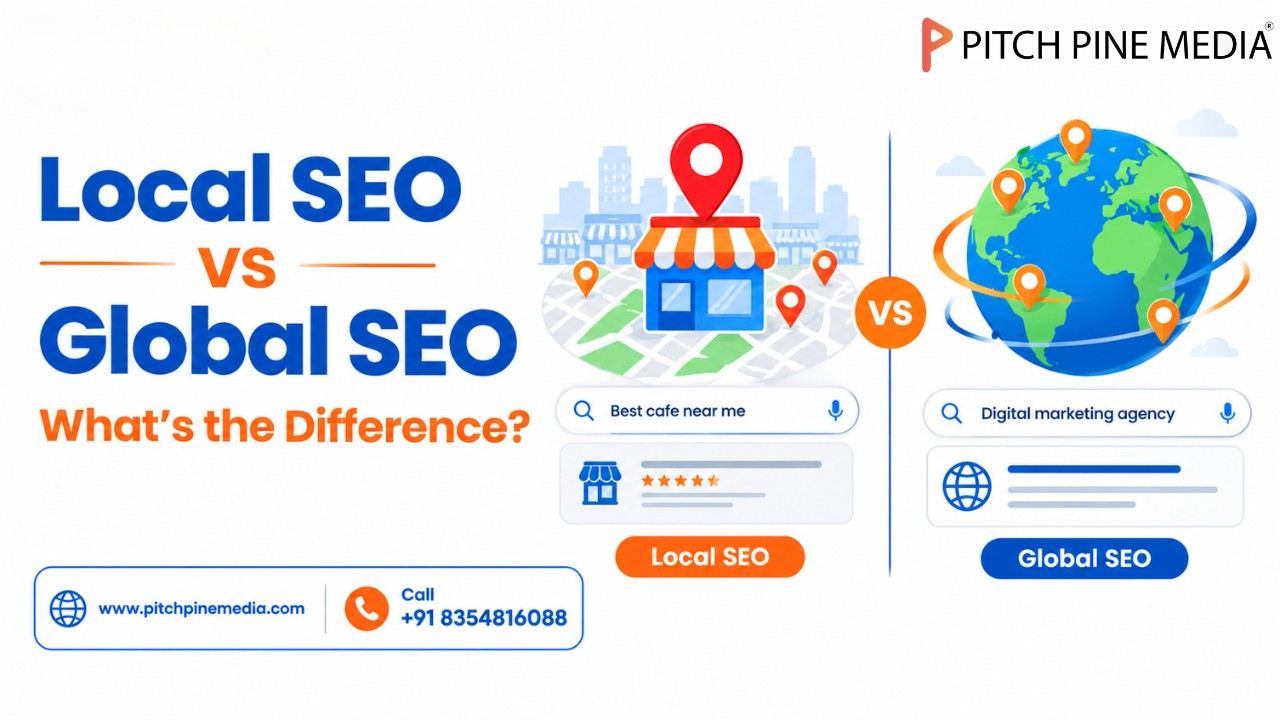
Local SEO focuses on improving visibility for searches connected to a specific geographic area, such as a city, neighborhood, or service region. Global SEO focuses on reaching audiences across multiple countries, markets, and sometimes languages.
For businesses planning to expand beyond their current market, developing a strong Global SEO Strategy can help create a scalable foundation for international search visibility.
In this guide, we will explain the key differences between local and global SEO, when each approach makes sense, how international SEO works, and what businesses should consider when choosing between the two.
What Is Local SEO?
Local SEO is the process of optimizing a business’s online presence to appear in search results for people looking for products or services in a specific geographic area.
For example, a plumbing company serving West Palm Beach may want to appear when someone searches:
- Plumber in West Palm Beach
- Plumbing services near me
- Emergency plumber in West Palm Beach
- Local plumbing company in Palm Beach County
The search intent is strongly connected to location.
Local SEO is particularly important for businesses that serve customers at a physical location or travel to customers within a defined service area.
Examples include:
- Plumbers
- HVAC companies
- Dentists
- Restaurants
- Contractors
- Law firms
- Medical practices
- Real estate businesses
- Auto repair shops
- Local professional services
Key Elements of Local SEO
A local SEO campaign may include:
- Google Business Profile optimization
- Local keyword research
- Location-specific landing pages
- Local citations
- Online reviews
- Local link building
- Local content
- NAP consistency
- Local schema markup
- Internal linking
- Technical SEO
- Local competitor analysis
Google Business Profile can be particularly important because local businesses may appear in Google’s local results and map listings in addition to the standard organic search results.
What Is Global SEO?
Global SEO, often called international SEO, focuses on improving a website’s visibility across multiple countries or international markets.
Instead of targeting customers in one city or region, a business may want to reach users in countries such as:
- United States
- United Kingdom
- Canada
- Australia
- Germany
- France
- India
- Singapore
For example, an ecommerce company selling products internationally may want its website to rank for relevant searches in the U.S., Canada, and the UK.
A software company may also target businesses in several countries, while a professional service provider may create separate strategies for different international markets.
Global SEO is therefore more than simply adding country names to keywords. It requires a structured approach to targeting different markets while maintaining a technically sound website.
Local SEO vs Global SEO: The Main Difference
The simplest distinction is geographic targeting.
Local SEO generally focuses on a specific geographic market, while global SEO focuses on multiple countries or international markets.
| Factor | Local SEO | Global SEO |
| Primary target | City, region, or service area | Multiple countries or international markets |
| Main goal | Reach nearby customers | Reach audiences in different countries |
| Keyword targeting | Location-specific keywords | Country, language, and market-specific keywords |
| Google Business Profile | Often highly important | Usually less central for global targeting |
| Content | Localized content | Country- or language-specific content |
| Website structure | Location/service pages | International folders, subdomains, or domains |
| Citations | Local directories | Country-specific directories and sources |
| Reviews | Local customer reviews | Reviews across target markets |
| Languages | Usually one language | May require multiple languages |
| Competitors | Local competitors | International and market-specific competitors |
| Technical complexity | Generally lower | Generally higher |
Neither approach replaces the other in every situation. A business can also use both.
For example, a company with physical locations in several countries may need a combination of local SEO and global SEO.
Why Local SEO Is Important for Local Businesses
Local searches often indicate that a person is looking for a business, product, or service within a specific area.
Consider someone searching for:
“Dentist near me.”
That search is very different from:
“Best dental implant technology.”
The first query has a strong local intent. The second may be informational and could attract users from anywhere.
For a local service business, ranking for broad informational keywords alone may not generate the same business opportunities as appearing prominently for searches made by people in its service area.
Local SEO helps businesses connect their website and business profile with the geographic areas they serve.
Why Global SEO Matters for International Businesses
Businesses expanding into international markets face a different set of challenges.
A website that performs well in one country does not automatically perform equally well in another.
Search behavior can differ based on:
- Language
- Search terminology
- Consumer preferences
- Competition
- Local regulations
- Cultural expectations
- Currency
- Search volume
- Search engine usage
- Local competitors
For example, a keyword that has strong search demand in the United States may have little demand in another country.
This is why an effective Global SEO Strategy begins with market research rather than simply translating existing pages.
What Is a Global SEO Strategy?
A Global SEO Strategy is a structured plan for improving a website’s visibility across multiple international markets.
The strategy should determine:
- Which countries to target
- Which languages to support
- Which keywords users search in each market
- How the website should be structured
- Which pages need localization
- How international competitors are performing
- Which technical SEO elements need to be implemented
- How content should be created for each market
- How authority and links will be developed
- How performance will be measured by country
A strong international strategy should balance scalability with local relevance.
Step 1: Identify Your Target Countries
Not every country will be equally valuable for your business.
Before creating international pages, analyze factors such as:
- Existing website traffic
- Leads and conversions
- Search demand
- Revenue potential
- Market competition
- Product availability
- Service availability
- Language requirements
- Local business conditions
A business may discover that three international markets offer significantly more opportunity than ten markets with minimal search demand.
Step 2: Perform Country-Specific Keyword Research
One of the most important differences between local and global SEO is keyword research.
You should not assume that people in different countries use exactly the same search terms.
For example, users in the United States, United Kingdom, Canada, and Australia may use different terminology for similar products or services.
Country-specific keyword research can reveal:
- Search volume
- Search intent
- Local terminology
- Commercial keywords
- Informational keywords
- Long-tail opportunities
- Competitor keywords
This information can then guide content and landing-page creation.
Step 3: Choose the Right International Website Structure
Businesses targeting multiple countries need a clear website structure.
Common options include:
Country-Code Top-Level Domains
Example:
example.us
example.co.uk
example.ca
This approach clearly separates country markets but can require more resources to maintain.
Subdirectories
Example:
example.com/us/
example.com/uk/
example.com/ca/
Subdirectories allow international content to remain within the primary domain.
Subdomains
Example:
us.example.com
uk.example.com
ca.example.com
Subdomains can separate markets while remaining connected to the main domain.
There is no universal structure that is best for every business. The appropriate option depends on factors such as branding, resources, technical requirements, market strategy, and the existing website.
Step 4: Use Hreflang Correctly
For websites serving similar content to users in different countries or languages, hreflang can help search engines understand which version of a page is intended for which audience.
For example, a company could have separate versions of a page for:
- English-speaking users in the U.S.
- English-speaking users in the UK
- French-speaking users in Canada
Hreflang implementation needs to be technically accurate. Incorrect or incomplete implementation can create confusion for search engines.
Step 5: Localize Rather Than Simply Translate
Translation and localization are not the same thing.
Translation converts content from one language to another.
Localization adapts the content to the audience and market.
Localization may involve adapting:
- Currency
- Measurements
- Terminology
- Examples
- Offers
- Calls to action
- Contact information
- Legal information
- Cultural references
- Product descriptions
For international SEO, simply using automated translation and publishing identical pages may not provide the best experience for users.
Local SEO and Global SEO Can Work Together
Local SEO and global SEO are not necessarily competing strategies.
A large international company may need both.
Consider a healthcare company with locations in:
- Phoenix
- Scottsdale
- Los Angeles
- London
- Toronto
The company could use a global SEO framework to manage its international markets while using local SEO strategies for individual locations.
The website may have country-level pages, followed by city or location pages underneath them.
This creates a layered SEO structure:
Global → Country → Region → City → Service
The exact structure depends on the business and its geographic footprint.
Local SEO vs Global SEO Keyword Strategy
Keyword targeting is another major difference.
Local SEO Keywords
Local businesses may target terms such as:
- HVAC company in Boston
- Dentist in Scottsdale
- Plumber in West Palm Beach
- Roofing contractor in Tucson
- Restaurant near me
These keywords combine a service or product with geographic intent.
Global SEO Keywords
An international company may target:
- Enterprise SEO software
- International payroll services
- Global logistics company
- SaaS platform for businesses
- Digital marketing services
The business may then create country-specific variations based on actual search behavior.
For example:
SEO Services USA
SEO Services UK
SEO Services Canada
However, simply changing the country name is not enough. The page should provide genuinely relevant information for the intended market.
Content Strategy for Local SEO
Local content should demonstrate relevance to the specific community or service area.
Examples include:
- Local service pages
- City guides
- Neighborhood content
- Local FAQs
- Service-area pages
- Local case studies
- Community involvement
- Location-specific blog content
The goal is to provide useful information for people in the geographic area rather than creating pages that only repeat the city name.
Content Strategy for Global SEO
Global content requires a broader market perspective.
International content may include:
- Country-specific service pages
- Market guides
- International case studies
- Country-specific FAQs
- Localized product pages
- Regional industry content
- Country-specific pricing information
- Local regulations and requirements where relevant
The content should match the search intent and expectations of the specific market.
Link Building: Local vs Global SEO
Link acquisition also differs depending on the target audience.
Local Link Building
Local businesses may benefit from relevant links from:
- Local organizations
- Chambers of commerce
- Local publications
- Community websites
- Regional directories
- Local industry associations
- Community events
Global Link Building
International businesses may need links from relevant websites in different countries and industries.
A global link strategy can involve:
- International publications
- Industry websites
- Country-specific publications
- Business organizations
- Research websites
- Regional associations
- Relevant international partnerships
The focus should remain on relevance and quality rather than simply obtaining a large number of links.
Technical SEO Considerations
Technical SEO is important for both local and global websites, but international websites often require additional planning.
A global website may need to manage:
- International URL structures
- Hreflang
- Canonical tags
- Country targeting
- Language targeting
- Duplicate or near-duplicate content
- International redirects
- XML sitemaps
- Indexation
- Page speed
- Mobile usability
- Structured data
- Internal linking
As the number of countries and languages increases, the potential for technical issues also increases.
This is why technical SEO should be part of the international strategy from the beginning rather than added after hundreds or thousands of pages have been published.
How to Choose Between Local SEO and Global SEO
The right approach depends on the business model.
Local SEO May Be Appropriate If:
- You serve customers within a defined geographic area.
- Your business has physical locations.
- Customers visit your location.
- You provide services within a specific region.
- Most leads come from nearby customers.
- Your business depends heavily on local search demand.
Global SEO May Be Appropriate If:
- You sell products internationally.
- Your services are available in multiple countries.
- You operate international offices.
- You are expanding into new markets.
- Your target customers are distributed across countries.
- Your website receives international traffic.
- You want to build visibility in multiple search markets.
You May Need Both If:
- You have offices in several countries.
- You serve local customers and international customers.
- You operate franchises across multiple regions.
- You sell internationally but also have physical locations.
- You have country-level and city-level target markets.
Common Global SEO Mistakes
International SEO can become complicated quickly. Some common mistakes include:
1. Translating Everything Automatically
Automated translation can produce awkward wording or fail to match how people actually search.
2. Using the Same Content for Every Country
Country-specific pages should provide genuine value instead of changing only the country name.
3. Ignoring Search Behavior
A keyword that works in one market may not be the phrase people use in another.
4. Incorrect Hreflang
Incorrect language or regional targeting can create technical SEO problems.
5. Creating Too Many Pages Too Quickly
Expanding into dozens of countries without sufficient demand or resources can create thin or low-value pages.
6. Ignoring Local Competitors
International competitors may differ significantly from the competitors you see in your primary market.
7. Treating International SEO as Translation
Successful international SEO requires market research, technical planning, localization, content development, and ongoing measurement.
Measuring Local SEO vs Global SEO Performance
The metrics you monitor should reflect the strategy.
Local SEO Metrics
You may track:
- Local keyword rankings
- Google Business Profile visibility
- Calls
- Direction requests
- Website visits
- Local organic traffic
- Leads
- Reviews
- Local conversions
Global SEO Metrics
You may track performance by:
- Country
- Language
- Organic traffic
- Keyword rankings
- Search visibility
- Leads
- Conversions
- Revenue
- Indexed pages
- International landing-page performance
For an international campaign, analyzing data at the country level can reveal which markets are generating meaningful opportunities.
How Pitch Pine Media Can Help With Global SEO
Businesses entering international markets need more than basic keyword optimization. They need a strategy that connects technical SEO, content, keyword research, localization, authority building, and performance measurement.
Pitch Pine Media provides Global SEO Services designed to help businesses build search visibility across international markets.
An international campaign can include:
- International keyword research
- Country-specific SEO strategy
- Technical SEO
- International website architecture
- Hreflang implementation
- Content strategy
- On-page optimization
- International link building
- Competitor research
- Localized landing pages
- Performance tracking
- Ongoing SEO improvements
The approach can be adapted based on the countries, languages, products, services, and business objectives involved.
For businesses planning international expansion, a structured Global SEO Agency can help establish a stronger foundation before scaling content and landing pages across multiple markets.
What to Look for in the Best International SEO Services
When evaluating Best International SEO Services, businesses should look beyond promises of rankings.
Consider whether an SEO provider can support:
- International keyword research
- Technical SEO
- Hreflang
- Multilingual and multi-regional websites
- Content localization
- Country-level competitor analysis
- International link building
- Analytics and reporting
- Conversion tracking
- Scalable website architecture
International SEO requires coordination across multiple areas of search optimization. A provider should be able to explain how each part of the strategy supports the overall business goal.
Final Thoughts:
The main difference between local SEO and global SEO is the audience and geographic scope being targeted.
Local SEO helps businesses become more visible to customers in specific cities, regions, or service areas.
Global SEO helps businesses build organic visibility across multiple countries and international markets.
Neither approach is automatically appropriate for every business. The right strategy depends on where your customers are, how your business operates, which markets you want to reach, and how your website is structured.
For a local service business, a focused local SEO campaign may be the appropriate starting point. For a company expanding internationally, developing a structured Global SEO Strategy can help create a scalable foundation for multiple markets.
And for businesses that need help managing international search visibility, professional Global SEO Services can bring together technical SEO, content, localization, keyword research, and international optimization under one strategy.
Pitch Pine Media can help businesses evaluate their current search presence and develop an SEO strategy based on their target markets, services, and growth plans.
Frequently Asked Questions
Q. What is the difference between local SEO and global SEO?
Ans: Local SEO focuses on improving search visibility within a specific geographic area, while global SEO targets users across multiple countries or international markets.
Q. Is local SEO part of global SEO?
Ans: They are separate areas of SEO, but they can work together. A business with locations in multiple countries may use global SEO at the country level and local SEO for individual cities or locations.
Q. Does global SEO require a multilingual website?
Ans: Not always. A business can target multiple countries where the same language is used. However, businesses entering markets with different languages may need localized or translated content.
Q. What is a Global SEO Strategy?
Ans: A Global SEO Strategy is a plan for improving a website’s organic visibility across multiple countries or international markets. It can include international keyword research, website structure, localization, technical SEO, content, and link building.
Q. How long does global SEO take?
Ans: The timeline varies based on the website’s authority, competition, target countries, technical condition, content quality, and resources available. International SEO is generally an ongoing process rather than a one-time project.
Q. Can a small business use global SEO?
Ans: Yes. A small business can target one or a few international markets if its products or services are available there. Starting with carefully selected markets can make the strategy more manageable.
Q. Should I create separate pages for every country?
Ans: Not necessarily. Country-specific pages should be created when there is a genuine audience, search demand, and useful information to provide. Creating large numbers of nearly identical pages can create quality and indexation challenges.
Q. What are Global SEO Services?
Ans: Global SEO Services are SEO solutions designed to improve organic search visibility across international markets. Depending on the business, they may include international keyword research, technical SEO, localization, hreflang, content strategy, competitor analysis, and international link building.
Q. How can Pitch Pine Media help with international SEO?
Ans: Pitch Pine Media can support international SEO through services such as international keyword research, technical SEO, content strategy, website optimization, competitor analysis, and other SEO activities tailored to the target markets.