

A Global SEO Strategy is the process of optimizing a website to rank across multiple countries and languages by combining technical infrastructure (hreflang tags, URL structure, geo-targeting), market-native keyword research, content localization, and regional authority building. Unlike basic SEO, which targets a single market, international SEO coordinates all of these elements simultaneously across multiple regions. Businesses partnering with a Global SEO Agency see measurable organic growth in new markets within 4 to 6 months when the technical foundation is correctly implemented from the start.
Pitch Pine Media, ISO-certified Global SEO Agency with 70+ in-house SEO specialists serving clients across the USA, UK, Australia, and APAC.
Introduction: Why Global SEO Is No Longer Optional
The total market size of global SEO services amounted to $92.74 billion in 2025 and the market continues to grow. It means that one fact that has to be acknowledged by all companies who strive to expand globally is that domestic SEO services are not sufficient anymore. Customers from the United States, Great Britain, Germany, Australia and all countries of the APAC region actively search for your products/services online.
Most companies think about global SEO in terms of translation when they translate existing content into other languages and then hope to get good ranking results. But in 2026, this strategy will fail since search engines analyze the content from the standpoint of entities and cultures and provide higher rankings to the content that is familiar to the target market audience.
International SEO Strategy involves much more than translation and this guide discusses all aspects of it.
What Is Global SEO? (And How It Differs From Regular SEO)
Global SEO is the practice of optimizing a website so that search engines can correctly identify which countries and languages each page is intended for and serve the right version to the right audience.
Standard SEO targets one geographic or linguistic segment. International SEO coordinates technical infrastructure, content strategy, and localization efforts across multiple countries simultaneously.
The key differences:
- Standard SEO → One country, one language, one set of keywords, one SERP
- Global SEO Strategy → Multiple countries, multiple languages, independent keyword research per market, multiple SERPs, and a unified technical architecture holding it all together
For businesses targeting the US, UK, or Australian markets from India, the gap between these two approaches directly determines whether international campaigns generate revenue or simply generate reports.
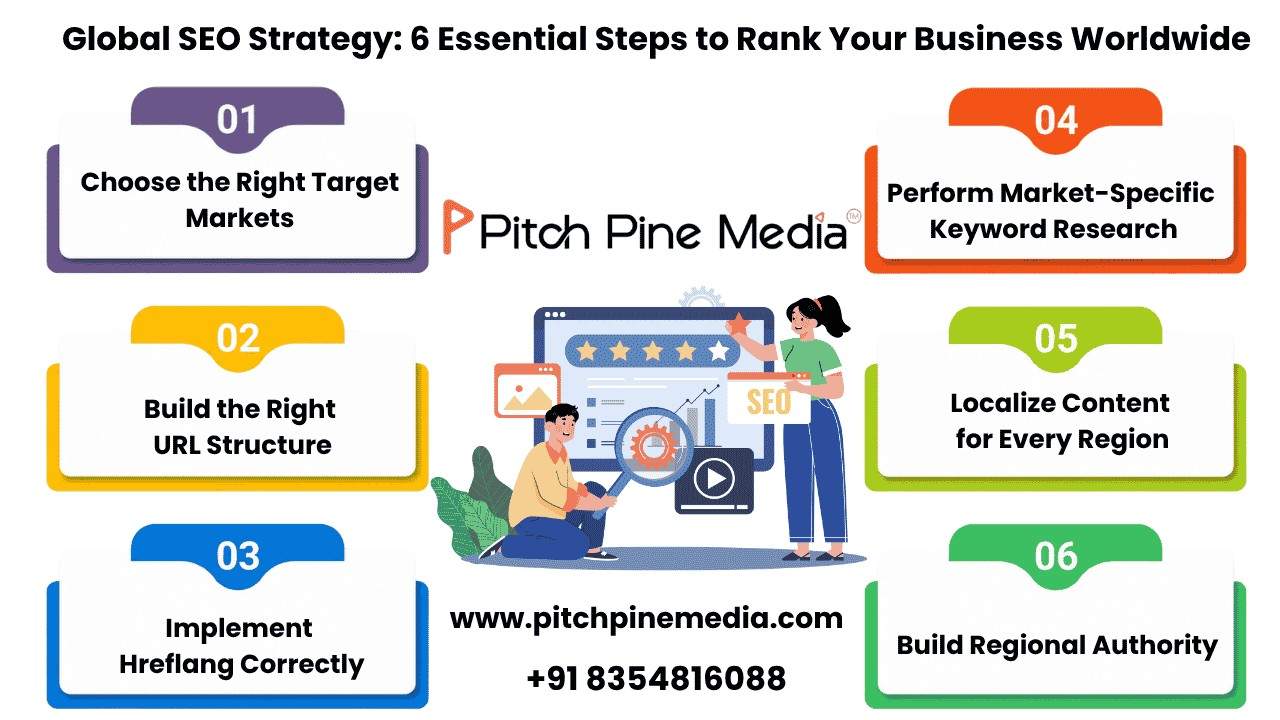
Step 1: Market Selection Where to Expand First
The most costly mistake in International SEO is expanding into too many markets simultaneously without the resources to do any of them well.
Before optimizing a single page, identify your highest-priority markets by evaluating:
- Existing organic traffic signals– Which countries are already sending traffic to your site, even without optimization?
- Commercial intent in each market – A country with high traffic but low conversion potential is not a priority
- Competitive landscape – Some markets have deeply entrenched local competitors; others have clear ranking opportunities
- Language and resource requirements – Each language requires dedicated native content not translation, localization
A focused approach two to three markets done correctly consistently outperforms a scattered approach across ten markets done superficially.
Step 2: URL Structure The Technical Foundation of International SEO
Your URL structure is one of the most consequential decisions in any Global SEO Strategy. It determines how search engines understand your international intent and how efficiently domain authority flows across markets. The three options each carry specific trade-offs:
ccTLDs (Country Code Top-Level Domains) Example: example.de, example.co.uk Strongest geo-targeting signal available. Builds immediate local trust with users. Requires independent link-building and domain authority maintenance per domain, a significant ongoing resource commitment. Best suited for major brands with established local operations and substantial SEO budgets.
Subdirectories Example: example.com/de/, example.com/au/ The recommended starting point for most businesses. All link equity from your existing domain flows to international sections without additional investment. A single CMS manages all language versions. Core Web Vitals, backlink authority, and domain trust benefit every international section simultaneously. Requires correct hreflang implementation because the domain itself does not convey country targeting.
Subdomains Example: de.example.com Treated by Google as separate websites, which splits domain authority. Useful when international offerings differ significantly from the primary market, but rarely the right choice for growing businesses entering new markets.
For most businesses working with a Global SEO Agency, subdirectories are the recommended default consolidated authority, lower management overhead, and a faster path to ranking in new markets.
Step 3: Hreflang The Most Misunderstood Technical Element
Hreflang is an HTML attribute that informs search engines about which language and regional variant of a page needs to be shown to the particular audiences. If done right, hreflang avoids duplicate content problems on a market-by-market basis and serves the proper page ranking in the proper country.
As per industry statistics, close to 75% of international websites have hreflang mistakes; however, resolving such mistakes is very important for proper international indexing and achieving maximum international traffic.
Three things that absolutely need to be done for hreflang to work properly:
- Self-referencing tags – Every page must include its own hreflang tag pointing back to itself
- Symmetric annotations – If page A references page B, page B must reference page A
- Valid ISO codes – Language codes follow ISO 639-1 (e.g., en, de, fr); region codes follow ISO 3166-1 Alpha-2 (e.g., GB, AU, IN)
A single structural change to URL templates or page architecture can break the entire hreflang system across an international site. Auditing hreflang after every major site update is not optional, it is maintenance.
Step 4: International Keyword Research Not Translation, Independence
This is where most International SEO Strategy implementations fail. Translating your existing keyword list into target languages produces a list of terms that may not match how users in those countries actually search.
Research conducted independently per market consistently outperforms translated keyword lists because:
- Search terminology varies between countries that share the same language (US English vs. UK English vs. Australian English)
- Purchase intent phrases differ across markets even for identical products
- Cultural references, regional terminology, and vernacular search language are invisible to translation tools
The practical approach: conduct keyword research in each target market using local search data, native speaker input, and local SERP analysis, not a translation of the primary market’s keyword set.
Step 5: Content Localization Beyond Translation
76% of online buyers prefer product information in their native language. 40% never purchase from foreign-language websites. These figures make content investment in target languages a direct revenue decision, not a marketing preference.
But language alone is not enough. Global SEO in 2026 requires localization adapting not just the language, but the meaning, cultural context, examples, regulatory references, and calls-to-action for each market. This is the foundation of what our Multilingual SEO service is built around every language version treated as its own independent content project, not a translation of the primary market.
Content that performs in the US may require:
- Different examples and case studies for a UK audience
- Different regulatory context for an Australian or European audience
- Different pricing references and payment options for APAC markets
- Different tone, formality level, and cultural references for each region
Machine translation, even with AI assistance, consistently produces content that ranks poorly and converts worse because it misses the cultural nuance that makes content feel locally relevant. Native speaker involvement in content creation is not optional; it is a ranking factor in practice if not in name.
Step 6: Regional Authority Building
Technical infrastructure and localized content create the foundation. Regional authority building, earning backlinks and brand mentions from locally relevant, authoritative sources is what pushes international rankings from page two to page one.
Effective regional link-building strategies include:
- Local press and PR coverage in target markets a single editorial feature in a regional publication can carry more weight than dozens of generic directory links
- Guest contributions on industry publications that hold authority in the target country our Guest Posting Services are built specifically for this purpose
- Regional business partnerships that produce co-marketing content and mutual backlinks
- Local directory citations consistent business name, address, and phone data across market-specific directories
For enterprise-level websites managing thousands of pages across multiple regions, authority building at scale requires a structured approach which is why Enterprise SEO and global link-building work hand in hand.
Each market requires its own regional authority program. A backlink from a UK-based publication carries more weight for UK rankings than ten links from US sites; the geographic relevance of the linking domain matters in international SEO.
Global SEO in the Age of AI Search
International SEO Strategy in 2026 must account for a shift that most global SEO frameworks have not fully addressed: AI-driven search systems evaluate international content at the entity and concept level, not the page level.
When multiple pages across your international properties cover the same topic, AI retrieval systems determine which version is most current, most semantically clear, and most locally authoritative then use that version as the preferred reference across markets regardless of hreflang configuration.
This is where Answer Engine Optimization (AEO) and Generative Engine Optimization (GEO) become critical layers of any modern global SEO strategy ensuring your international content is not just indexed, but actively cited by AI search systems across every target market.
How Pitch Pine Media Delivers Global SEO Results
With 70+ in-house SEO specialists and over a decade of experience executing International SEO campaigns for clients across the US, UK, Australia, and APAC, Pitch Pine Media builds global SEO strategies that work at every layer technical, content, and authority.
Our Global SEO Services cover market selection and competitive analysis, URL structure planning, hreflang audit and implementation, market-native keyword research, content localization with native writer involvement, regional link-building, and monthly performance reporting all under a single ISO-certified process.
For agencies, our White Label SEO Services deliver the same international SEO capability under your brand, with full confidentiality and scalable capacity. And for businesses looking to reduce overhead without compromising quality, our SEO Outsourcing Services offer a flexible, cost-effective path to global SEO execution.
A Global SEO Agency that has done this across dozens of markets and industries carries the institutional knowledge of what actually works in each region and what doesn’t. That experience is the difference between a global SEO strategy that produces compounding international revenue and one that produces reports.
Get a Free Global SEO Consultation →
Frequently Asked Questions
Q. How long does Global SEO take to show results?
Ans: International SEO campaigns typically show measurable organic growth within 4 to 6 months in markets where the technical foundation is correctly implemented. Markets with stronger competition or significant localization gaps may take 9 to 12 months.
Q. What is the difference between Global SEO and Local SEO?
Ans: Local SEO targets a specific city or region within a single country. Global SEO targets multiple countries and languages simultaneously, requiring a significantly more complex technical architecture and independent content strategy per market.
Q. Is machine translation acceptable for international SEO content?
Ans: No. Machine translation produces content that search engines can index but that consistently underperforms against natively written content. 40% of online buyers never purchase from foreign-language websites content that feels translated rather than local falls into this category.
Q. Which URL structure is best for international SEO?
Ans: Subdirectories are the recommended default for most growing businesses. They consolidate link equity under one domain, simplify management, and provide a faster path to ranking in new markets than ccTLDs, which require independent link-building per domain.