

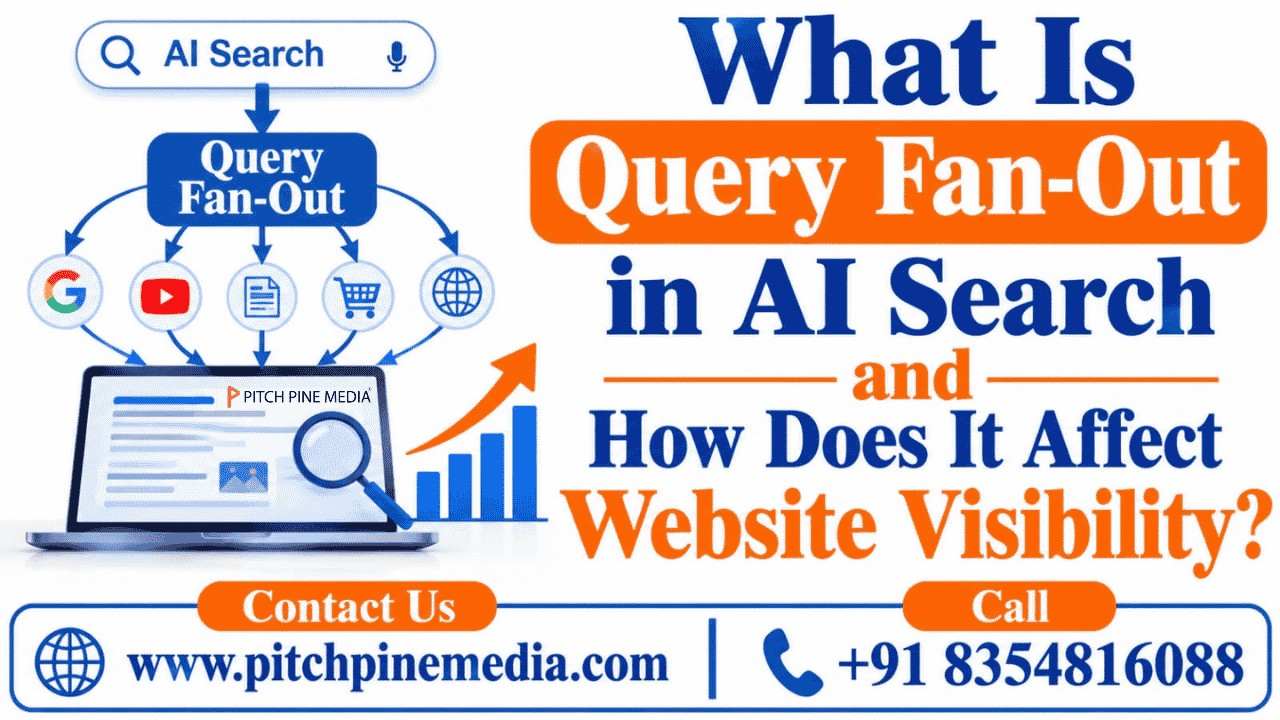
Search has quietly changed. When someone asks Google AI Mode, ChatGPT, Gemini or Perplexity a question, the system does not simply look up that one phrase. It breaks the question into many smaller searches, collects evidence for each one, and builds a single answer. This hidden process is called query fan-out, and it decides which websites get mentioned and which stay invisible.
If your pages rank well but never show up inside AI answers, query fan-out is often the reason. In this guide, a trusted AI SEO Agency in India explains what query fan-out is, how it works, how it affects your website’s visibility, and what you can do to win more citations.
What Is Query Fan-Out in AI Search?
Query fan-out is the technique AI search engines use to expand one user question into multiple related sub-queries, run them in parallel, and combine the results into one synthesized, cited answer.
Google has explained this method for its AI Mode and AI Overviews. Other AI search platforms use a similar approach. Instead of looking at one keyword and showing ten website links, AI tries to understand what the user is actually looking for. It also searches for other related questions that can help provide a better answer.
For example, when someone searches for “the best AI SEO company for an ecommerce brand in India,” the AI tool may also search for answers to questions like:
- What services does an AI SEO company offer?
- Which Indian companies specialize in ecommerce SEO?
- What is the cost of AI SEO services?
- Does the company have successful projects or case studies?
- What do customers say about its services?
While searching for these questions, AI finds information from different websites. Your brand might appear in all these results, in just a few of them, or may not appear at all. This is why businesses should build their presence on multiple trusted online platforms instead of depending only on their own website.
How Query Fan-Out Works: Step by Step
Implementations differ between platforms, but the flow is broadly the same.
1. Intent interpretation
The model reads the prompt and works out the goal, context, and likely follow-up needs. A short query can carry several intents at once: informational, comparative, and transactional.
2. Sub-query generation
The system creates multiple rewritten and related queries. These cover subtopics, comparisons, definitions, alternatives, pricing, location, and risks.
3. Parallel retrieval
Each sub-query is searched at the same time across the web index and, in some systems, other sources such as maps, shopping data, and knowledge graphs.
4. Passage selection
The engine does not always choose whole pages. It often selects specific passages that answer a sub-query clearly, which is why well-structured sections matter so much.
5. Synthesis and citation
The language model merges the evidence into one answer and attaches sources. Pages that supplied clear, trustworthy, corroborated information earn the AI search citations.
For a deeper look at the selection stage, read our guide on how AI decides which brands to mention in search answers.
Traditional Search vs Query Fan-Out Search
| Factor | Traditional SEO Search | Query Fan-Out AI Search |
| Query handling | One query, one results list | One prompt becomes many sub-queries |
| Winning unit | The page | The passage or answer block |
| Success metric | Ranking position and clicks | Mentions, citations and inclusion in answers |
| Content strategy | Target one primary keyword | Cover the entire topic cluster |
| Trust signals | Backlinks, relevance | Backlinks, entity clarity, reviews, corroboration |
Ranking first for a single keyword no longer guarantees visibility. You need to be useful across the whole conversation around that keyword.
How Query Fan-Out Affects Website Visibility
1. You can rank and still be invisible
A page may rank in the top three for your main keyword, yet the AI answer is assembled from sub-queries your page never addresses. Competitors with fuller topic coverage get cited instead.
2. Topical depth beats keyword matching
Because every sub-query is a new chance to be retrieved, thin pages lose. Brands that answer definitions, comparisons, pricing, process, and objections tend to appear more often. This is why AI brand visibility now depends on topic coverage, not just keyword placement.
3. Passage quality becomes a ranking factor
A vague paragraph is rarely extracted. A direct, self-contained answer with a clear heading, a defined entity, and supporting detail is far more likely to be used.
4. Clicks may fall, influence rises
AI answers can satisfy users without a visit. But being named or cited builds recognition and trust. Over time, strong citations feed online brand authority, branded search, and higher-intent leads.
5. Trust and consistency are checked across the web
AI systems cross-check claims. If your services, location, and expertise are described consistently on your website, directories, social profiles, and third-party mentions, you are easier to trust and cite. Our post on authority marketing and brand trust explains how to build this signal.
How to Optimize Your Website for Query Fan-Out
1. Map the sub-queries behind your main keywords
Before writing, list the follow-up questions a buyer would ask. Use People Also Ask, AI Mode follow-ups, sales call transcripts, support tickets, and forum threads. Group them into themes: what, why, how, cost, comparison, risks, and next steps.
2. Build topic clusters, not isolated pages
Create a pillar page for the main topic and supporting pages for each sub-topic, all connected with descriptive internal links. For example, a pillar on AI SEO can be supported by pages on AEO, GEO, and LLM optimization.
3. Lead every section with a direct answer
Place a clear 40 to 60 word answer right under each question-style heading, then expand with detail. This is the format answer engines can lift easily.
4. Use question-based headings and FAQs
Headings such as “How much do AI SEO Services in India cost?” mirror the sub-queries AI systems generate. Add FAQ sections with concise, factual answers.
5. Add structured data and clean technical SEO
Use Article, FAQ, Organization, LocalBusiness, Product, and Review schema where relevant. Keep pages crawlable, fast, mobile-friendly, and free of rendering problems, because retrieval can only use what it can access.
6. Strengthen entity clarity
State who you are, what you do, where you operate, and who you serve in plain language. Keep your brand name, address, services, and descriptions identical across your site and profiles.
7. Publish original, quotable information
AI systems favour content with something new to add: first-hand experience, real examples, original data, process breakdowns, and expert commentary. Generic rewrites are easy to replace.
8. Earn off-site corroboration
Mentions on reputable sites, quality guest posts, reviews, interviews, and industry listings all reinforce your authority. Our guest posting services help brands build relevant, trustworthy mentions.
9. Keep content fresh
Update statistics, screenshots, pricing, and examples regularly, and show clear published and updated dates.
Why AEO, GEO and SEO Must Work Together
Query fan-out sits where three disciplines meet.
- SEO makes sure your pages are crawlable, indexable, relevant, and authoritative, so they can enter the retrieval pool at all.
- AEO (Answer Engine Optimization) structures content as direct, concise answers for featured snippets, voice assistants, and AI summaries. Learn more about our Answer Engine Optimization services.
- GEO (Generative Engine Optimization) improves the odds that generative systems mention and cite your brand inside synthesized answers. Explore our Generative Engine Optimization services.
If you also want visibility inside chat-style assistants, our LLM optimization services and ChatGPT SEO work cover that layer. To see how the three fit together in practice, read how AI SEO works for AEO, GEO and AI search.
Real Examples of Fan-Out Content Planning
For an Ecommerce Store: When someone searches for “best running shoes for flat feet under 5,000 rupees,” AI may look at different things, such as foot support, cushioning, brand comparisons, prices, shoe sizes, and customer reviews. To help your products appear in AI search results, product pages should include clear details, product comparisons, buying guides, and customer reviews. You can also read our article on Ecommerce SEO and GEO for better product visibility in AI search.
For a Service-Based Business: If someone searches for a “trusted digital marketing agency in Lucknow,” AI may look for information about services, experience, pricing, customer reviews, previous projects, and business location. Your website, Google Business Profile, customer testimonials, and case studies should provide clear and consistent information.
For a B2B Business: When someone searches for “how to choose a white label SEO partner,” AI may explore different factors, including pricing, reporting, work quality, contracts, and communication. You should cover each topic in a separate section or create dedicated pages to explain them properly.
How to Measure Visibility in a Query Fan-Out World
Rankings alone are not enough. Track:
- Citation frequency: how often your domain is cited in AI Overviews, AI Mode, ChatGPT, Gemini, and Perplexity for your target prompts
- Brand mentions: whether you are named, even without a link
- Prompt coverage: how many relevant sub-topics your content addresses
- Share of voice: your presence compared with competitors across a set of tracked prompts
- Branded search growth: a useful signal of rising awareness
- Assisted conversions: leads that mention AI tools or arrive through branded queries
Test a fixed list of 30 to 50 prompts monthly and record who gets cited. The gaps show exactly which sub-queries you are losing.
Common Mistakes to Avoid
- Targeting one keyword per page and ignoring related questions
- Writing long introductions before getting to the answer
- Hiding key information inside images, tabs, or scripts that are hard to crawl
- Publishing generic AI-written content with no original insight
- Inconsistent brand, address, and service details across the web
- Ignoring off-site mentions, reviews, and digital PR
- Measuring success only by clicks and average position
For a practical checklist on the platform side, see key strategies to optimize your website for ChatGPT search and Google AI Overviews.
Why Work With an AI SEO Agency in India?
Query fan-out demands research, content depth, technical precision, and authority building working together. A specialist AI SEO Agency in India can map sub-queries, restructure content for answer engines, fix technical blockers, and track AI search citations across platforms, usually at a more efficient cost than agencies in the US or Europe.
When choosing an AI SEO Company in India, look for:
- A clear process covering SEO, AEO, and GEO, not just rebranded traditional SEO
- Proof of work, such as case studies, testimonials, and transparent reporting
- Content that shows real expertise, not templates
- Technical, schema, and entity optimization skills
- Honest expectations, since no one can guarantee a citation in an AI answer
At Pitch Pine Media, our AI SEO Services in India include topic and prompt research, fan-out mapping, content restructuring, schema and technical fixes, authority building, and citation tracking. Our goal is simple: stronger AI brand visibility, more AI search citations, and lasting online brand authority for your business. You can explore the full scope on our AI SEO services page.
Conclusion
Query fan-out has changed the way people search online. Now, AI doesn’t just look for one keyword. It searches for answers to several related questions before giving a final response. This means your website needs to provide useful information on different topics instead of focusing on just one keyword.
Businesses with helpful content, clear answers, strong online presence, and mentions on trusted websites have a better chance of appearing in AI search results and earning customer trust.
Want more people to discover your brand through AI search? Connect with Pitch Pine Media, a trusted AI SEO Agency in India. Our team can help you create an SEO, AEO, and GEO strategy that matches how modern AI search works. Contact our team today to get started.