

People have more choices than ever when deciding which business to trust. They can compare websites, read reviews, check social profiles, search for answers, watch videos, and ask AI-powered search tools for recommendations before contacting a company.
That changes what marketing needs to accomplish.
Getting your business in front of people is only one part of the process. You also need to give them reasons to believe that your brand understands its industry and can genuinely help them.
This is where Authority Marketing becomes valuable.
Authority marketing focuses on building recognition and credibility by consistently demonstrating expertise through content, search visibility, social media, public-facing knowledge, customer experiences, and other digital touchpoints. Instead of simply telling people that a business is trustworthy, the strategy creates evidence that allows potential customers to reach that conclusion themselves.
For businesses investing in building brand authority, this can become a long-term approach to attracting customers who already have confidence in what the brand represents.
What Is Authority Marketing?
Authority Marketing is a strategy focused on establishing a business, professional, or brand as a credible source of information within its industry.
It can involve several activities working together, including:
- Educational blog content
- Search engine optimization
- Thought leadership
- Social media content
- Case studies and original insights
- Digital PR
- Customer reviews and testimonials
- Industry-focused resources
- Video and other educational formats
- Consistent brand communication
- A strong, trustworthy website
The idea is straightforward: demonstrate expertise instead of simply claiming it.
For example, a healthcare company can publish genuinely useful information that answers common patient questions. A financial business can create educational resources that explain complicated concepts clearly. A technology company can publish practical guides, research, and insights about problems its customers regularly face.
Over time, these activities can contribute to stronger online brand authority.
Why Does Brand Authority Matter?
Trust influences how people evaluate businesses.
Imagine that two companies offer similar services. One has a website with detailed resources, useful answers, consistent branding, active social profiles, positive customer feedback, and content that demonstrates knowledge of the industry.
The other has a basic website with very little information.
Even before speaking to either company, a potential customer may have a different impression of each business.
That is the practical connection between authority and trust.
Strong authority does not guarantee that someone will choose your business. But consistently demonstrating expertise can help reduce uncertainty during the research stage.
This is particularly important for businesses selling services that require customers to make a considered decision.
Authority Marketing vs. Traditional Brand Promotion
Traditional promotion often focuses on communicating what a business sells.
Authority marketing adds another layer: why should someone believe this business understands the problem?
Consider a simple difference.
A traditional promotional message might say:
“We provide professional SEO services for growing businesses.”
An authority-focused approach could explain:
- Why technical SEO problems affect organic visibility
- How businesses can identify indexing issues
- What changes after a website migration
- How content quality influences search performance
- Which SEO metrics actually matter
- Common mistakes businesses make when optimizing websites
The second approach gives the audience something useful before asking for anything in return.
That is why content marketing for brand authority can be such an important part of the overall strategy.
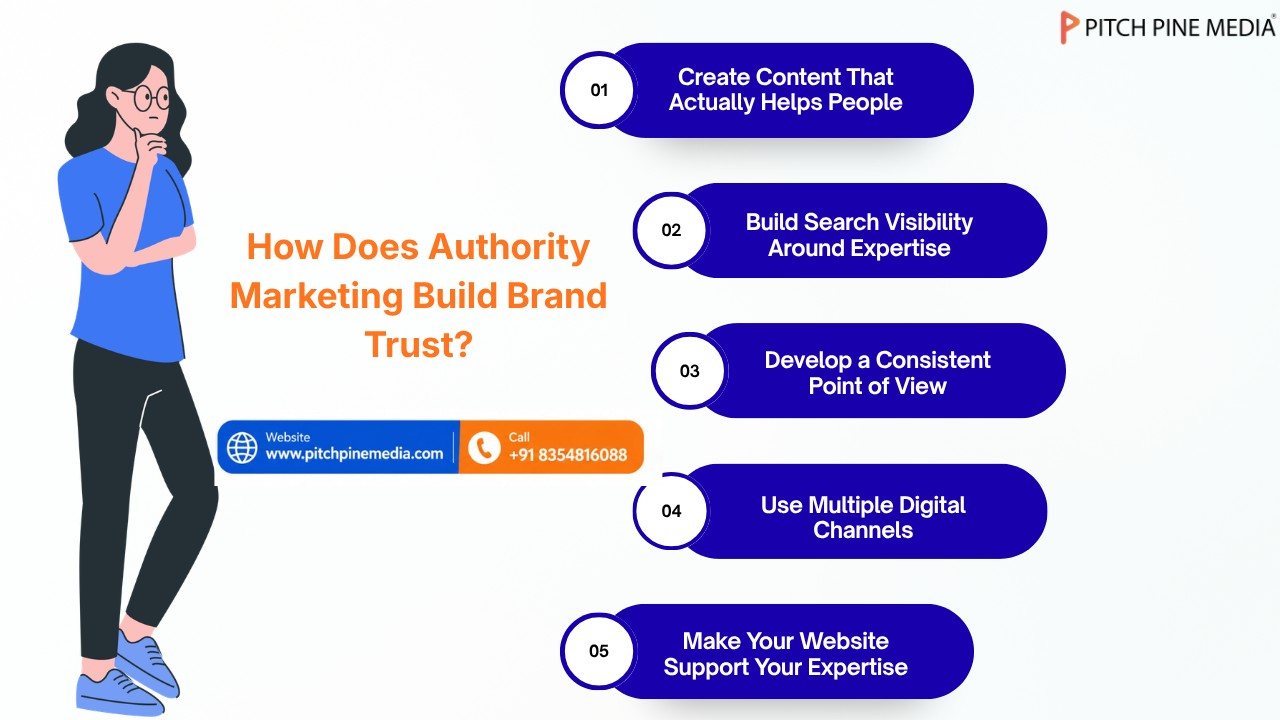
How Does Authority Marketing Build Brand Trust?
Authority is rarely created by one blog post or one social media campaign. It develops through repeated signals.
Here are some of the most important components.
1. Create Content That Actually Helps People
Useful content should answer real questions.
Instead of producing articles simply because a keyword has search volume, identify what your audience genuinely wants to understand.
That could include:
- How-to guides
- Industry explanations
- Comparisons
- Research-based articles
- Troubleshooting resources
- Expert commentary
- Frequently asked questions
- Original observations
- Case studies
The objective is not to make every piece promotional.
If every article ends up being a sales pitch, readers have less reason to return.
A better marketing strategy for building trust treats education as part of the customer journey.
2. Build Search Visibility Around Expertise
SEO and authority marketing can work together.
Search visibility helps people discover your content when they are already looking for information. A well-structured SEO strategy can make authoritative resources easier to find.
This includes technical optimization, relevant keyword targeting, useful content, internal linking, on-page optimization, and other SEO fundamentals.
Pitch Pine Media provides SEO services covering areas such as technical SEO, on-page SEO, off-page SEO, website optimization, and content marketing.
Businesses interested in using search as part of their authority strategy can also explore SEO and digital marketing services from Pitch Pine Media.
3. Develop a Consistent Point of View
Authority is easier to recognize when a brand has something meaningful to say.
That does not mean publishing controversial opinions just to attract attention.
Instead, develop a clear perspective based on genuine experience, research, customer questions, industry developments, and useful observations.
For example, a real estate company could regularly discuss changes in its local market, explain buying considerations, and answer common property questions.
A marketing company could break down changes in search, advertising, content, or analytics.
Consistency helps turn individual pieces of content into a recognizable body of knowledge.
4. Use Multiple Digital Channels
Your audience does not necessarily discover your business through Google alone.
They may find you through:
- YouTube
- Industry publications
- Google search
- Business directories
- Podcasts
- Email newsletters
- Referrals
- Online communities
This is where digital authority marketing becomes broader than SEO.
The same expertise can be adapted for different platforms without simply copying and pasting the same content everywhere.
A detailed article could become a LinkedIn post, a short video, an infographic, an email, or a series of social posts.
5. Make Your Website Support Your Expertise
Your website is often where people go after discovering your brand.
A strong authority-building website should make it easy for visitors to understand:
- What the company does
- Who it serves
- What problems it solves
- Why its expertise is relevant
- What information it provides
- How people can contact the business
Website design also matters because credibility is affected by the overall user experience.
Clear navigation, helpful content, readable pages, transparent information, and consistent branding all contribute to the experience.
Building Brand Authority Through Thought Leadership
Thought leadership is often associated with executives, founders, consultants, and subject-matter experts.
But it does not have to mean writing long opinion pieces about every industry trend.
Good thought leadership can be practical.
For example, a business leader might explain:
- A lesson learned from a project
- A common misconception in their industry
- An emerging customer problem
- A change affecting their market
- A practical framework for solving a recurring issue
The strongest thought leadership is connected to genuine knowledge.
A thought leadership marketing agency can help businesses identify topics, develop content ideas, distribute expertise across channels, and maintain consistency.
However, outsourcing the production of content should not mean inventing expertise. The information needs to come from legitimate knowledge, research, data, or real business experience.
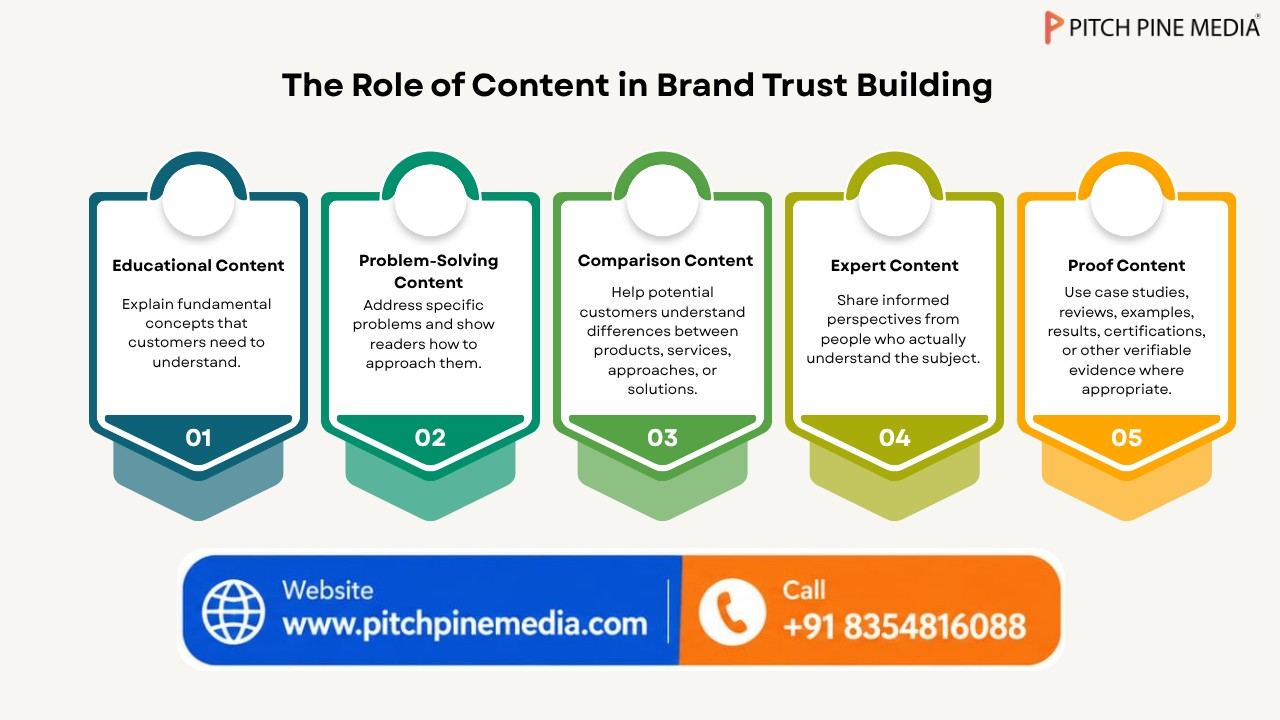
The Role of Content in Brand Trust Building
Content is one of the most visible ways a business can demonstrate what it knows.
But more content does not automatically mean more authority.
A company publishing 50 shallow articles may create less trust than a company publishing 15 genuinely useful resources.
Quality should therefore come before volume.
A useful content strategy can include different layers.
Educational Content
Explain fundamental concepts that customers need to understand.
Problem-Solving Content
Address specific problems and show readers how to approach them.
Comparison Content
Help potential customers understand differences between products, services, approaches, or solutions.
Expert Content
Share informed perspectives from people who actually understand the subject.
Proof Content
Use case studies, reviews, examples, results, certifications, or other verifiable evidence where appropriate.
Together, these formats create a stronger foundation for brand trust marketing.
How SEO Supports Online Brand Authority
SEO can contribute to authority by connecting useful information with people actively searching for it.
Suppose someone searches for a specific problem related to your industry.
If your website consistently provides useful answers to related questions, the visitor may encounter your brand multiple times during their research.
That repeated exposure can strengthen familiarity.
It can also create opportunities for users to explore deeper resources on your website.
This is one reason internal linking matters. A detailed blog post can lead a reader to a relevant service page. A service page can point to a case study. A case study can lead to another educational resource.
Pitch Pine Media’s own content marketing offering includes blogging, articles, social media content, video creation, and press releases, showing how different content formats can be combined within a broader digital strategy.
Authority Marketing in the Age of AI Search
Search behavior is changing.
People increasingly use AI-powered tools to find explanations, compare options, and discover businesses. That means brands need information that is clear, specific, useful, and supported by genuine expertise.
This makes authority even more relevant.
AI search optimization should not mean writing content specifically to manipulate an AI system. Instead, businesses should make their expertise easy to understand.
That means:
- Answering questions directly
- Explaining concepts clearly
- Using accurate terminology
- Supporting important claims
- Providing useful context
- Demonstrating first-hand expertise where available
- Keeping business information consistent
- Creating genuinely valuable resources
The same principles that make content useful to human readers can also make it easier for search systems to interpret.
Pitch Pine Media’s current blog includes content addressing AI SEO and how businesses can improve visibility in AI-driven search environments.
Online Reputation and Brand Authority Work Together
Reputation and authority are related, but they are not identical.
Authority focuses heavily on what a business demonstrates about its expertise.
Reputation is influenced by what customers and other people say about the business.
Both matter.
A company can publish excellent educational content but still struggle with trust if its customer experience consistently creates negative feedback.
That is why online reputation and brand authority should be considered together.
Businesses should monitor reviews, respond professionally to customer feedback, maintain accurate business information, and make sure their public communications match the actual customer experience.
Marketing cannot permanently compensate for a poor product or service.
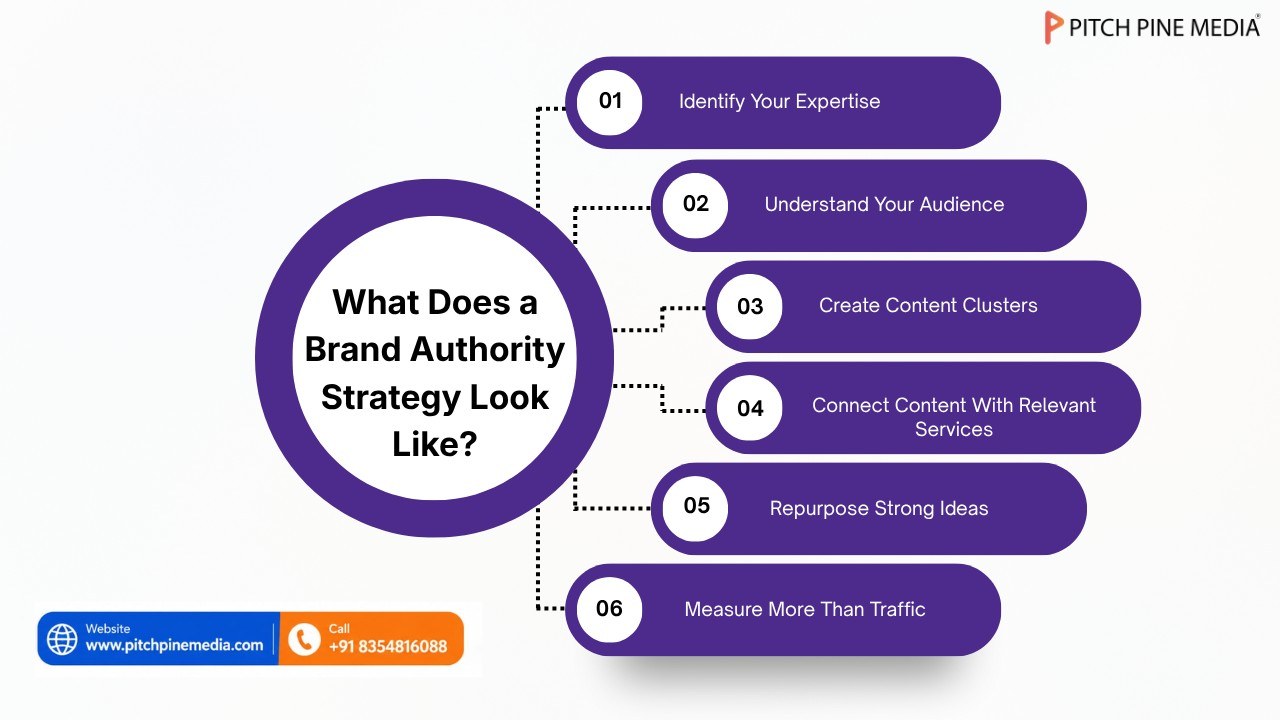
What Does a Brand Authority Strategy Look Like?
A practical strategy can be built around several stages.
Step 1: Identify Your Expertise
List the subjects your business genuinely understands.
Think beyond your services. Consider the questions customers ask before buying, common mistakes, industry challenges, and problems your team regularly solves.
Step 2: Understand Your Audience
Find out what customers search for, what concerns them, and what information they need before making a decision.
This helps prevent content from becoming disconnected from actual customer needs.
Step 3: Create Content Clusters
Instead of publishing unrelated articles, organize content around major areas of expertise.
For example, a digital marketing company could build separate content clusters around SEO, paid advertising, content marketing, social media, analytics, and website optimization.
Step 4: Connect Content With Relevant Services
Content should naturally lead readers to the next useful resource.
If an article explains why a business needs technical SEO, a relevant technical SEO service page can provide more detailed information.
The connection should be useful rather than forced.
Step 5: Repurpose Strong Ideas
A good article does not have to live only on a blog.
Turn useful ideas into short videos, social posts, newsletters, presentations, downloadable resources, or expert commentary.
Step 6: Measure More Than Traffic
Traffic is useful, but it is not the only signal.
Depending on the business, measure:
- Branded search growth
- Qualified organic traffic
- Engagement
- Returning visitors
- Leads
- Content-assisted conversions
- Mentions
- Reviews
- Referral traffic
- Search visibility
- Conversion rates
The right metrics depend on the goals of the business.
When Should a Business Invest in Authority Marketing?
Authority marketing can be particularly useful for businesses where customers spend time researching before contacting a provider.
This includes areas such as:
- Professional services
- Healthcare
- Real estate
- Financial services
- Technology
- B2B services
- Education
- Consulting
- Home improvement
- Hospitality
- Specialized local services
However, authority building is not limited to these industries.
Any business that needs customers to trust its expertise can benefit from demonstrating that expertise consistently.
How Can a Digital Marketing Agency Help Build Brand Authority?
Authority building usually involves several channels rather than one isolated campaign.
A brand building marketing agency can help coordinate SEO, content, social media, paid campaigns, website improvements, analytics, and other digital activities around a common objective.
Pitch Pine Media describes itself as a full-service digital solutions partner, with services including SEO, paid search, paid social, data and analytics, UI/UX, and web development.
Its content marketing services also cover blogs, articles, social media posts, video creation, and press releases.
That type of integrated approach can be useful because authority is rarely created by one marketing channel working alone.
Why Consistency Matters More Than One Big Campaign
A business might publish one impressive report, run a major campaign, or receive a significant media mention.
Those things can create attention.
But authority is built through repeated evidence.
Customers should be able to encounter a consistent brand across search results, website pages, social profiles, content, reviews, and other digital touchpoints.
This is why digital marketing for brand authority should be viewed as a long-term process.
The goal is not simply to create one viral moment.
It is to build a digital presence that continues demonstrating expertise after the campaign ends.
Common Authority Marketing Mistakes
Authority marketing can lose effectiveness when businesses approach it like traditional advertising.
Publishing Content Without Expertise
Writing about a subject without understanding it can result in generic content that adds little value.
Chasing Every Trend
Not every trending topic is relevant to your audience. Focus on subjects connected to your expertise and customer needs.
Making Unsupported Claims
Statements such as “industry leader,” “best,” or “number one” should not replace evidence.
Over-Promoting Every Article
If every educational resource immediately becomes a sales pitch, readers may stop seeing the content as genuinely useful.
Ignoring Customer Experience
Brand authority cannot exist separately from what customers actually experience.
Measuring Only Traffic
High traffic does not automatically mean stronger trust or better business outcomes.
Building Brand Authority Is a Long-Term Investment
Authority is not something a business can simply purchase overnight.
It develops as customers repeatedly encounter useful information, consistent messaging, credible expertise, positive experiences, and evidence that supports the brand’s claims.
A strong marketing strategy for building trust therefore needs patience and consistency.
For Pitch Pine Media, that means combining the capabilities already available across SEO, content marketing, social media, paid advertising, analytics, web development, and other digital services into strategies built around each client’s specific objectives. The company states that its digital marketing approach is customized for businesses rather than treating every client the same.
Businesses interested in understanding how this approach can fit their goals can also review Pitch Pine Media’s digital marketing services and digital marketing case studies for more context.
Build Trust by Showing What Your Brand Knows
Customers do not have to believe a brand simply because its advertising says it is trustworthy.
They can see it through the information the business publishes, the questions it answers, the expertise it demonstrates, the experiences customers share, and the consistency of its digital presence.
That is the real value of Authority Marketing.
For businesses focused on building brand authority, the goal should not be to appear knowledgeable. It should be to become genuinely useful to the people they want to serve.
When SEO, content, social media, reputation, website experience, and thought leadership work toward that same goal, marketing becomes more than a way to generate attention. It becomes a way to build familiarity, credibility, and long-term brand trust.