


Quick Answer
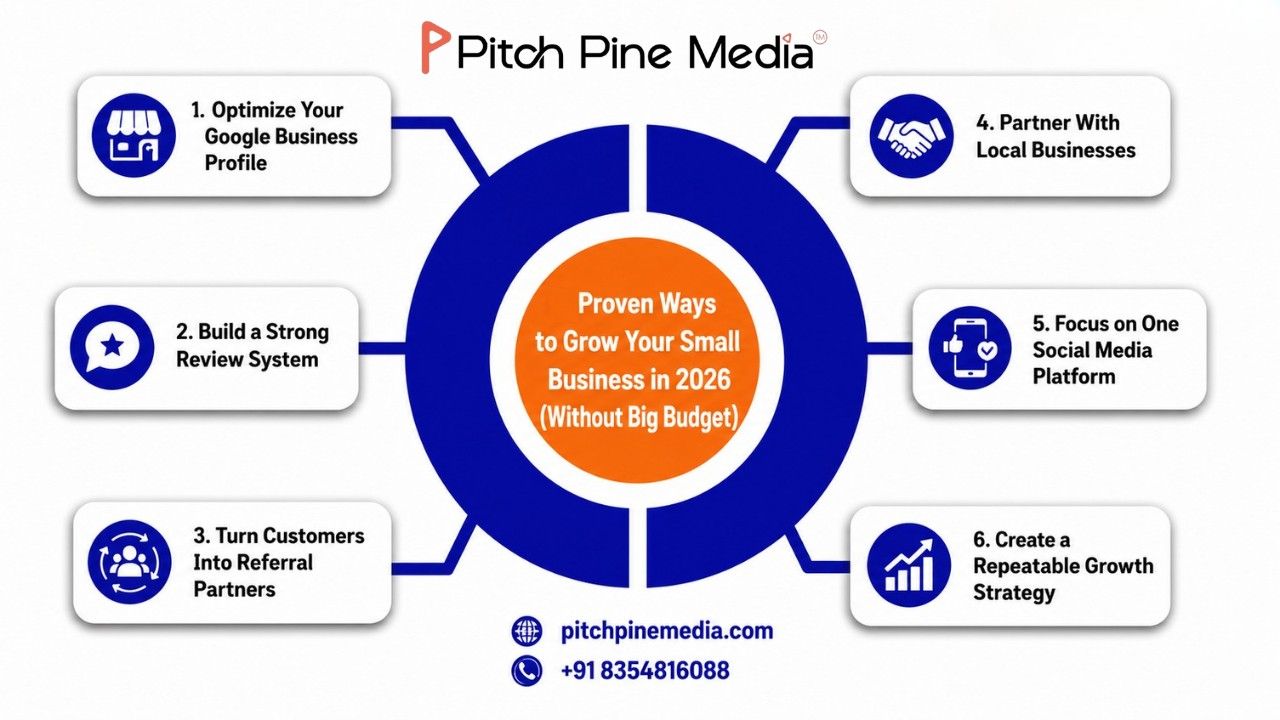
You don’t need a big ad budget to get more customers online. The highest-impact, lowest-cost tactics in 2026 are optimizing your Google Business Profile, systematically asking happy customers for reviews, activating word-of-mouth and referral programs, partnering with complementary local businesses, and posting consistently on one social platform instead of spreading yourself thin across five. In fact, 83% of small businesses say customer referrals are their single best source of new customers and referrals cost nothing but a little structure and consistency.
Introduction
If you have ever looked at your marketing budget and said, “I simply cannot compete against large companies,” then you are far from being alone nor are you as helpless as you might believe yourself to be.
Paid advertising is effective, but it is certainly not the only path to growth; in many cases, it may not even be the most effective one. This statement is proven time and time again in statistics, where when small business owners are surveyed about their best customers, referrals easily win out over online advertising.
In the following sections, we look at five truly effective strategies for small businesses in 2026 that cost very little to nothing at all. They do not involve a degree in marketing; just consistency.
1. Optimize Your Google Business Profile (Zero Cost, Highest Leverage)
If you do only one thing after reading this article, make it this one.
Your Google Business Profile (GBP) is often the very first impression a potential customer has of your business. It’s what powers the map and the three-listing block that shows up when someone searches “[your service] near me” and it costs nothing to set up or maintain.
Despite this, a large share of small businesses either haven’t claimed their profile or have left it half-finished. That’s a real gap, and it’s one you can close this week.
What a complete profile includes:
- Your accurate business name, exactly as it appears in real life
- The correct primary and secondary business categories
- Complete hours, including holidays and seasonal changes
- Your full service area
- Real photos of your business, products, team, and completed work
- A clear, natural-sounding business description
Two habits that keep your profile working for you:
- Post weekly. Updates, offers, or upcoming events signal to Google that your listing is active and active listings get shown more often.
- Respond to every review. This isn’t just good customer service. It tells Google your business is engaged, and it tells potential customers you actually care what people think.
This single step can put your business in front of local searchers without spending a single rupee or dollar on advertising.
2. Ask for Reviews – Systematically, Not Randomly
Most small businesses know reviews matter. Few have an actual system for getting them. That’s the gap worth closing.
Before someone calls, emails, or fills out a contact form, they almost always look you up first and one of the first things they notice is your reviews. A strong review profile builds trust before a potential customer ever speaks to you directly. Reviews often answer a customer’s objections before they even reach out.
The good news: building review momentum doesn’t require anything complicated. It requires making it easy and making it a habit.
A simple system that works:
- Ask at the right moment. Right after a positive interaction, a completed job, a happy checkout, a resolved support call is when customers are most willing to leave a review.
- Make it physical. Creating a QR-code which links directly to your Google review page and placing it on your receipt or business card can be very helpful.
- Sending follow-up messages by text or email. A short and friendly message which has a direct link to the review page removes the only obstacle forgetting to leave a review.
- Setting realistic and growing targets. If you already have 10 reviews, set a target of 20 and so on.
When it comes to reviews consistency is better than intensity.
3. Activate Word-of-Mouth and Referral Programs
Let’s look at one statistic: 83% of small businesses consider customer referrals as their primary source of acquiring new customers and this ratio reaches even 87% for those companies that employ only ten workers or less.
Still, the majority of such companies don’t have any referral programs; they expect their happy customers to recommend them to someone else spontaneously, yet hope isn’t a method.
How to turn word-of-mouth into a repeatable channel:
- Make your call-to-action clear. After a successful collaboration, all you need to do is ask politely: “Do you know anybody who needs what you got here? It would be nice if you introduced him/her to us.“
- Provide some incentive. A discount for a future purchase, a small gift, and priority access to your products and services will encourage them to do that.
- Make it easy. Give your customers the possibility to send a referral via link, printed card, or brief message it will save them from extra efforts.
- Say thank you publicly (with your customer’s consent). A mention in social networks or a personal thank-you note will help to reinforce the positive habit of recommending your company.
Referrals will prove to be more effective than almost any other channel due to the existing trust.
4. Partner With Complementary Local Businesses
Not everyone needs a budget to take advantage of the other guy’s customers, all they need is the right partner.
Cross-promotion will work in situations where you can find two businesses catering to the same kind of people without going after the same sale. It could be a coffee shop that collaborates with a bakery, or a fitness center that partners with a local nutrition expert, or even a wedding photographer with a local florist.
How to find the right partner:
- Identify businesses with a similar target audience, but a different product or service
- Look for businesses that complement what you do, rather than compete with it
- Reach out directly most small business owners are open to mutually beneficial arrangements
Simple ways to activate the partnership:
- Recommend each other to customers directly
- Run a joint promotion or bundled offer
- Feature each other on social media or in email newsletters
- Co-host a small local event or workshop
This kind of partnership also tends to produce a useful side effect: a mention or link from your partner’s website, which can support your broader SEO visibility over time.
5. Post Consistently on One Platform – Not All of Them
A common mistake small businesses make is trying to maintain a presence on every social platform at once, then burning out within a month and abandoning all of them.
A far more effective approach: pick the one platform where your actual customers spend their time, and show up there consistently. Consistency, not platform count, is what builds an audience.
How to choose the right platform:
- Instagram – strong for visually appealing products, food, fashion, beauty, and design-led services
- Facebook – strong for local community businesses and an audience that skews slightly older
- YouTube – strong for service businesses that can demonstrate expertise through short how-to or behind-the-scenes content
What consistent posting actually requires:
No expensive studio or high-quality editing is required. The simple fact that the video is shot on your smartphone in under two to three minutes and features your product, answers a common customer question, or gives an inside look is often more effective than a polished one.
It is important to remember the additional perk here – videos are indexed by Google too, meaning that your video will help you achieve better overall SEO ranking as well.
Putting It All Together
None of these five strategies require a significant budget. What they require is structure and consistency turning things you’re probably already doing informally into a repeatable system.
| Strategy | Cost | Time to See Results |
| Google Business Profile optimization | Free | Days to weeks |
| Systematic review requests | Free | Weeks (compounds over time) |
| Referral program | Free to low-cost (small incentives) | Weeks to months |
| Local business partnerships | Free | Weeks to months |
| Consistent single-platform content | Free (time investment) | Months (compounds) |
Start with your Google Business Profile this week; it’s the fastest, highest-leverage fix on this list. Then layer in one additional strategy at a time. You don’t need to do everything at once. Pick one, build momentum, and add the next.
Ready to Grow Without a Big Budget?
If you’ve implemented these strategies and you’re ready to scale further or you simply want an expert eye on what’s working and what isn’t, a quick audit can show you exactly where the biggest opportunities are.
At Pitch Pine Media, we help small businesses build practical, budget-conscious digital marketing strategies that actually convert visitors into paying customers.
Get a Free Digital Marketing Audit from Pitch Pine Media
No long-term lock-in. No hidden costs. Just a clear, honest plan to help you grow.