

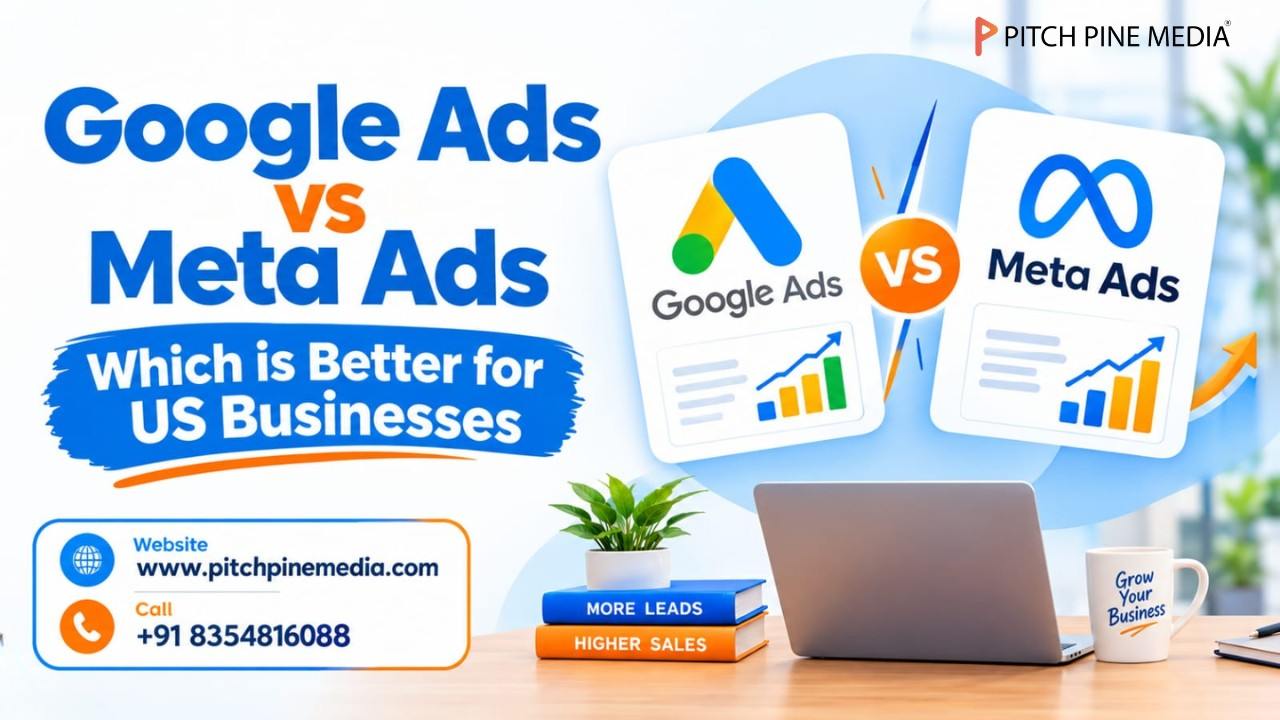
If you’re deciding where to invest your digital advertising budget, you’re probably asking the same question many business owners ask: Google Ads vs Meta Ads.
The answer depends on your business goals. If you want to reach people who are actively searching for your products or services, Google Ads is often the stronger choice. If your goal is to build brand awareness, engage new audiences, or promote visually appealing products, Meta Ads can deliver excellent results. For many US businesses, the most effective strategy is using both platforms together at different stages of the customer journey.
At Pitch Pine Media, we help businesses choose the right advertising strategy based on their industry, target audience, and marketing objectives rather than recommending one platform for everyone.
What Are Google Ads?
Google Ads is an advertising platform provided by Google that helps businesses place their ads on Google Search, YouTube, Google Maps, Gmail, Google Shopping, and countless partner websites.
The primary benefit of Google Ads is intent.
Whenever people search for something like:
- Emergency plumber near me
- Best accounting software
- Personal injury lawyer in Dallas
- Digital marketing agency in New York
People have a certain intention, and your company appears right when the customers are looking to take action, making Google Ads one of the most effective advertising platforms to catch leads.
When Does Google Ads Work Best
- Local service businesses
- Law firms
- Healthcare providers
- Home service businesses
- B2B businesses
- SaaS businesses
- Ecommerce businesses with search volume
Companies that need high-quality leads usually perform very well on Google Ads because it connects them with buyers who have a certain purchase intention.
What Are Meta Ads?
Meta Ads include advertising across:
- Messenger
- Meta Audience Network
Unlike Google, people using Facebook or Instagram usually aren’t searching for a product. They’re scrolling through their feed, watching videos, or interacting with friends.
This means Meta Ads focus on creating demand instead of capturing it.
Meta’s powerful audience targeting allows advertisers to reach people based on:
- Interests
- Age
- Location
- Lifestyle
- Online behavior
- Previous interactions
- Lookalike audiences
Instead of waiting for customers to search, Meta places your brand in front of potential buyers before they even realize they need your product or service.
Google Ads vs Meta Ads: The Biggest Difference
The biggest difference between Google Ads vs Meta Ads comes down to customer intent.
Google Ads capture existing demand.
Meta Ads create new demand.
Think about someone searching for “roof repair near me.”
They’re likely looking for a contractor today.
Now imagine someone scrolling Instagram who sees a beautiful outdoor renovation video. They weren’t planning to renovate their backyard, but the ad sparks interest.
Both users may become customers, but they enter the buying journey at completely different stages.
Understanding this difference is the key to choosing the right advertising platform.
When Google Ads Is Usually the Better Choice
Google Ads often performs better when customers already know what they need.
Examples include:
- Emergency services
- Medical clinics
- Mortgage companies
- Legal services
- Accounting firms
- HVAC companies
- Real estate agencies
These businesses depend on people actively searching for solutions.
For example, someone searching “family dentist in Chicago” is much closer to booking an appointment than someone casually browsing Instagram.
Because of this higher purchase intent, Google Ads often generate qualified leads more quickly, although the average cost per click may also be higher in competitive industries.
Example: A Portland Mortgage Company
Imagine a mortgage broker in Portland.
A person searching:
“First-time home buyer mortgage Portland”
is already researching lenders.
Showing a Google Search ad at that moment can lead directly to a consultation request.
That same user might never click a mortgage advertisement while scrolling Facebook because they’re not actively thinking about financing at that time.
This is why intent-driven businesses frequently prioritize Google Ads as part of their lead generation strategy.
When Meta Ads Make More Sense
Meta Ads often perform better for businesses that rely on strong visuals or emotional buying decisions.
Examples include:
- Fashion brands
- Beauty products
- Fitness businesses
- Restaurants
- Home décor
- Travel companies
- Lifestyle brands
These businesses benefit from attractive images and videos that inspire users before they begin searching.
For example, a luxury furniture company can showcase beautifully designed living rooms on Instagram and encourage users to imagine that style in their own homes.
Instead of responding to existing demand, Meta Ads help create interest and build brand awareness over time.
Google Ads vs Meta Ads: Side-by-Side Comparison
Understanding the strengths of each platform makes it easier to decide where your advertising budget will have the biggest impact.
| Feature | Google Ads | Meta Ads |
| User Intent | High. People are actively searching for a solution. | Medium to low. People are browsing content and discovering brands. |
| Best For | Lead generation, local services, B2B, high-intent purchases | Brand awareness, ecommerce, lifestyle brands, product discovery |
| Targeting | Keywords, search intent, location, demographics | Interests, behaviors, demographics, lookalike audiences |
| Ad Formats | Search, Display, Shopping, YouTube, Performance Max | Image, Video, Carousel, Reels, Stories |
| Buying Stage | Bottom of the funnel | Top and middle of the funnel |
| Typical Goal | Capture existing demand | Create new demand |
The biggest takeaway in the Google Ads vs Meta Ads discussion is that the platforms serve different purposes. Google helps you reach people who are ready to buy, while Meta helps you introduce your brand to new audiences and nurture future customers.
Which Platform Delivers Better ROI?
It is not a matter of one size fits all.
ROI depends on:
- Your industry
- Your target market
- Campaign setup
- Your landing pages
- Creatives
- Budgeting
For instance:
A personal injury lawyer firm in Texas may get more qualified leads from Google Search as the consumers will actively look for attorneys after an accident.
A skincare company introducing a new product will get better returns from Instagram Reels and Facebook video ads as it will create demand among consumers prior to searching for solutions.
The question is not about which platform provides better ROI but which platform suits your customers’ buyer’s journey.
Google Ads vs Meta Ads for Different Business Types
Local Service Businesses
Businesses like plumbers, dentists, HVAC companies, roofing contractors, and mortgage brokers usually benefit more from Google Ads because customers are searching with immediate intent.
Example searches include:
- Emergency dentist near me
- Mortgage broker Portland
- Roof repair Dallas
Showing up at the moment someone needs your service often leads to higher-quality enquiries.
Ecommerce Brands
Ecommerce businesses often achieve the best results by combining both platforms.
Meta Ads:
- Introduce products to new audiences.
- Build brand awareness.
- Generate engagement.
Google Ads:
- Capture shoppers searching for specific products.
- Drive conversions through Shopping Ads.
- Convert branded searches.
Together, these platforms create a complete customer journey.
Cost Comparison
Many business owners assume Meta Ads are always cheaper.
In reality, cost depends on competition and campaign quality.
Generally:
- Google Ads often have higher cost per click because advertisers compete for high-intent searches.
- Meta Ads usually offer lower costs for impressions and audience reach.
- Google often generates fewer but higher-intent leads.
- Meta can generate larger volumes of traffic, especially for awareness campaigns.
Looking only at cost per click doesn’t tell the full story. The true measure of success is how efficiently each platform helps you achieve your business goals.
Common Mistakes Businesses Make
Most business errors are due to selecting an inappropriate platform for an inappropriate goal.
Examples of some common errors include:
Focusing on One Platform
Many businesses are often unsure if they should focus on Google or Meta.
The truth is that many successful campaigns utilize both Meta and Google. Meta builds awareness, while Google captures demand generated from that awareness.
Overlooking Landing Pages
The best campaign may still fail if traffic lands on a slow or bad landing page.
Landing page optimization often generates more leads without increasing costs of advertisements.
Focusing On Clicks Only
Not all clicks are conversions and not all clicks are associated with income generation.
Instead, the right business indicators are:
- Cost per lead
- Conversion rate
- Customer acquisition cost
- ROAS (return on ad spend)
- CLTV (customer lifetime value)
Real Example
Imagine two US businesses with the same monthly advertising budget.
Business A: A plumbing company in Chicago.
People usually search Google when they have an urgent plumbing problem, making Google Ads the primary driver of qualified leads.
Business B: A premium furniture brand.
Customers may first discover the brand through Instagram videos, save products they like, visit the website later, and eventually complete their purchase through a Google search.
Both businesses succeed with paid advertising, but their customer journeys are completely different.
That’s why there isn’t a single answer to the Google Ads vs Meta Ads debate. The right platform depends on how your customers discover, research, and purchase your products or services.
Should US Businesses Choose Google Ads or Meta Ads?
If you’ve come up to this point, then you must have come to the realization that there is no absolute winner in this Google Ads Vs Meta Ads contest.
What matters most is the following factors:
- The goals of the business
- Target customer demographics
- Budget of the company
- Industry of the business
- Stage of customers within the buying funnel
When it comes to many US companies, then the best solution will not be to choose between the two but use both of the platforms in the areas they excel.
A Smart Full-Funnel Advertising Strategy
Instead of asking, “Which platform is better?” think about how customers make purchasing decisions.
A typical customer journey may look like this:
- A potential customer discovers your business through a Facebook or Instagram ad.
- They visit your website but don’t purchase it immediately.
- A few days later, they search Google for your brand or service.
- Your Google Search Ad appears.
- They visit your website again and convert into a customer.
This approach combines the strengths of both advertising platforms and often produces better long-term results than relying on just one channel.
Which Platform Should You Choose?
Here’s a simple guide.
Choose Google Ads if you want to:
- Generate qualified leads
- Capture high-intent searches
- Increase phone calls
- Drive local enquiries
- Sell products people actively search for
- Reach customers ready to purchase
Choose Meta Ads if you want to:
- Build brand awareness
- Reach new audiences
- Promote visual products
- Grow social engagement
- Launch new products
- Retarget website visitors
Use Both if you want to:
- Build awareness and generate leads
- Improve customer acquisition
- Support long sales cycles
- Increase return on ad spend
- Grow your business consistently
For many growing US businesses, combining Google Ads and Meta Ads delivers stronger long-term performance because each platform supports a different stage of the customer journey.
Why Work with Pitch Pine Media?
To run a profitable paid ad campaign, more than just picking the platform is needed. Structure, audience, landing pages, creatives, bidding, and optimization can affect the results of the campaign.
In Pitch Pine Media, we make sure to build data-based and goal-oriented PPC strategies for your company. If you require Google ads, Meta ads, landing page optimization, or an overall digital marketing plan, our team will help you increase your conversions and ROI.
We also assist companies with making themselves visible in search engines by offering SEO services, AI Search Optimization, Answer Engine Optimization (AEO), Generative Engine Optimization (GEO), Content Marketing, Technical SEO, and Local SEO.
Final Thoughts
This is not just a matter of Google Ads VS Meta Ads. This is a matter of selecting the appropriate platform at the appropriate time in the customer’s journey.
When your objective is to target those customers who are searching for your product/service, Google Ads should be the way to go. In case you wish to boost brand awareness and engage potential customers, then Meta Ads can do wonders.
Combining both Google Ads and Meta Ads in an effective marketing plan is the winning formula for many US companies.
Ready to Grow Your Business with Smarter Paid Advertising?
No matter if it’s your first marketing campaign or you need to optimize the performance of your current one, Pitch Pine Media will assist you in crafting a smart strategy that brings clear results.
Connect with us now to find out which solution, Google Ads or Meta Ads, would work better for you.
Frequently Asked Questions
Q. Is Google Ads better than Meta Ads?
Ans: No, not always. Google Ads usually outperforms Meta Ads in terms of reaching customers with high purchase intent, whereas Meta Ads are better at creating awareness about the company and its products.
Q. Which one is cheaper?
Ans: Meta Ads tend to be less expensive in terms of the cost per impression and audience reach. Google Ads will be more costly in terms of CPC, but the clicks generated via Google Ads come from people who are already looking for a solution to a problem. It depends on what exactly you aim to do.
Q. Which platform is better for local businesses?
Ans: Usually, Google Ads works great for reaching local service companies that customers search for in order to get some kind of services from them. Meta Ads can be used in order to increase local brand awareness and conduct remarketing campaigns.
Q. Can small businesses work with both platforms?
Ans: Yes, they definitely can. Many small companies prefer to choose only one platform first and then gradually go to another one depending on the current needs.
Q. Which one is better for e-commerce?
Ans: Both platforms have their role in the process. Meta Ads are great for product showcasing and creating demand. Google Shopping Ads and Search Ads attract customers who are looking for a product right now.