

Publishing a blog or service page is not the end of content optimization. Information changes, customer expectations evolve, search behaviour shifts and competitors publish new resources. A page that was useful a year ago may now contain outdated examples, incomplete answers or information that no longer reflects what users want to know.
This matters even more as people increasingly use AI-powered platforms to research products, compare services and find answers. Tools such as ChatGPT, Gemini and Perplexity can summarise information from different sources and, in some experiences, provide links or citations to the pages they use.
For businesses, this creates a reason to review existing website content instead of focusing only on publishing new articles. A well-maintained page can continue to answer relevant questions, provide accurate information and support the website’s overall search visibility.
This process is known as AI Content Refresh. It involves reviewing existing content, identifying gaps and updating information so that it remains useful for readers and easier for search systems to understand.
However, updating a publication date or adding a few keywords is not enough. A meaningful refresh should improve the information itself, strengthen its structure and make sure the page reflects current user needs.
What Is AI Content Refresh?
AI Content Refresh is the technique of analyzing and enhancing the quality of already existing website content to make it more accurate, relevant, complete and valuable for search experience in modern conditions of AI-powered search engines.
This approach includes both the traditional content optimization and the techniques needed for the Answer Engine Optimization (AEO) and Generative Engine Optimization (GEO).
In case of content refresh, a business may:
- Update statistics, facts and examples.
- Add the information on issues raised by new questions.
- Enhance the headings and content structure.
- Update information related to services, pricing, and specifications of the products.
- Add the relevant internal links to new content resources.
- Eliminate the information that appears to be repeated and irrelevant.
- Enhance the information related to the authors, references, and evidence.
- Make the key information more accessible.
For example, an article written in 2024 regarding AI SEO will provide the information about traditional search engine optimization but lack the important aspects related to AI-powered search. In order not to write another article about the same issues, one can refresh the content of the article and add information about AEO, GEO, AI citations and conversational queries.
Why Does Updated Content Matter for AI Search Citations?
Searches powered by AI technology require information which is capable of being analyzed within a context. In the case where the user asks a question, the AI system might analyze or utilize information from a range of sources to form a response.
A page containing out-of-date or uncontextualized information might be less helpful when answering contemporary questions.
Updating information helps to support the following important fields.
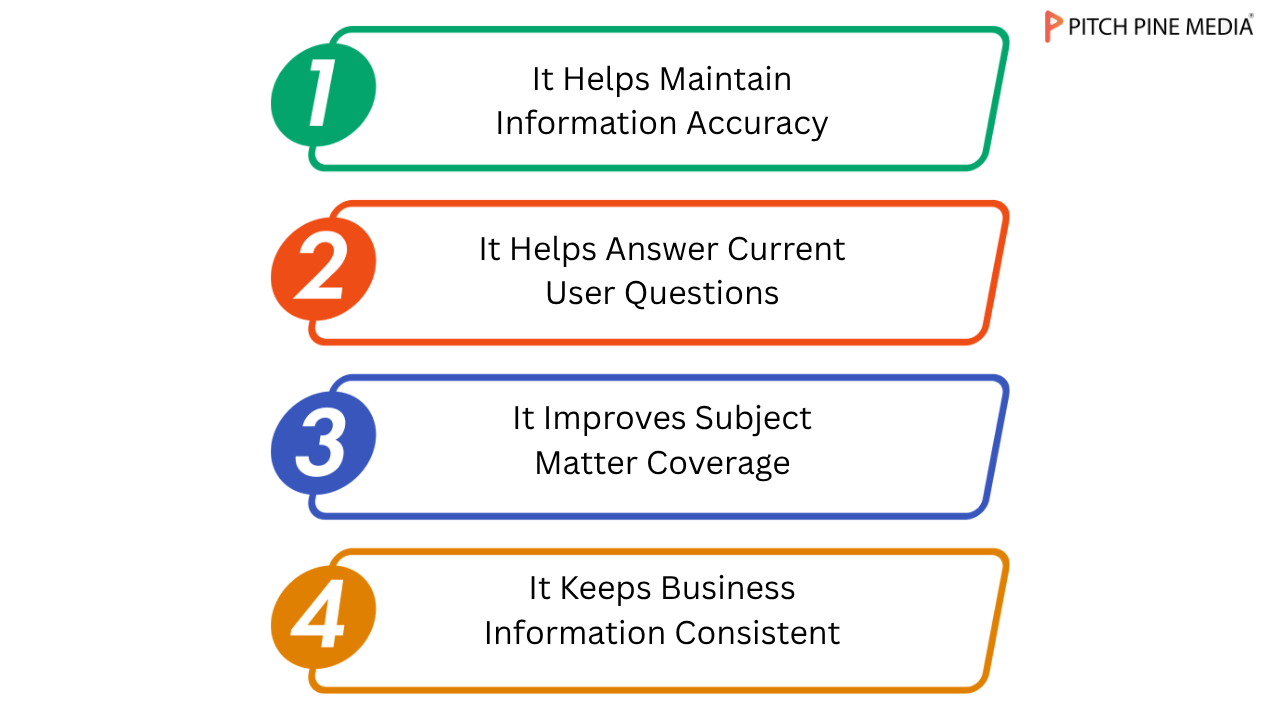
1. It Helps Maintain Information Accuracy
Let’s take the case where there is an online marketing company with a blog that talks about increasing business visibility on the internet using AI. In the course of time since its release, processes involved in the provision of the agency’s services might have been updated.
If the post still talks about the old process, then people reading it would not get full details about the matter at hand.
This is especially true in matters of technology, policy, price changes and more.
2. It Helps Answer Current User Questions
User queries evolve as users get acquainted with innovations.
For instance, several years ago, people used to query “What is SEO?” Now, there are some examples of questions like:
- What impact does SEO make on AI search visibility?
- How can a website acquire citations for its content via AI search?
- Will refreshing old content be good for GEO?
- How can businesses increase their visibility in ChatGPT?
Updating existing articles with appropriate questions can add value for users investigating the subject matter.
3. It Improves Subject Matter Coverage
One article can never address all questions regarding a particular subject. New related information may become relevant over time.
For example, an article on AEO can be updated with descriptions of conversational queries, structured data, entities, and AI search citations.
When all these related topics are interconnected with appropriate internal links, users can dive deeper into the subject matter.
4. It Keeps Business Information Consistent
AI search visibility does not only include individual blog posts. The website needs to convey consistent information about its branding, products, specialization, and target audience.
If some pages offer contradictory information, visitors will have difficulty comprehending the business’s offerings.
Service description, company info, author information, and related articles review can help achieve this goal.
How to Identify Website Content That Needs a Refresh
Not every page needs to be updated at the same time. Start by identifying pages where an update can improve user experience, search relevance or business performance.
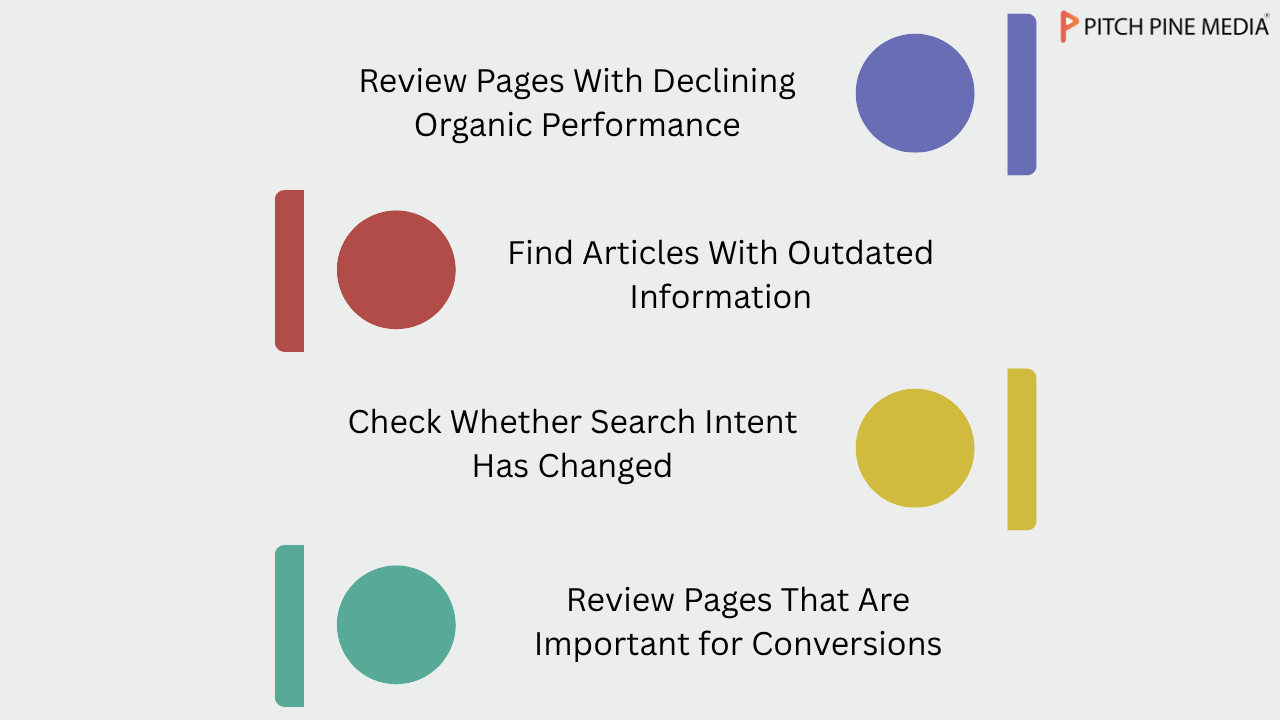
1. Review Pages With Declining Organic Performance
Google Search Console can assist in finding pages where the number of impressions, clicks or search rankings have changed.
Look out for:
- Pages with less organic click-through.
- Keywords where there is a drop in impressions.
- Pages that have gotten traffic before and now have declined.
- Pages showing up for a query where the content does not satisfy the search intent.
- Pages with many impressions but few clicks.
The drop doesn’t necessarily mean the page is outdated. Competition, technical problems, search intent and algorithm changes can be other reasons. Analyze these first before making any changes.
2. Find Articles With Outdated Information
Some pages clearly need attention because their information is no longer current.
Examples include:
- Articles mentioning discontinued tools or features.
- Blogs containing old statistics without relevant context.
- Service pages describing packages that have changed.
- Guides referring to outdated processes.
- Articles with broken internal or external links.
Prioritise pages where outdated information could mislead readers or affect their decisions.
3. Check Whether Search Intent Has Changed
A page may still target the correct keyword but fail to answer what users currently want to know.
For example, an article targeting “AI SEO services” may focus entirely on keyword research and traditional ranking improvements. Readers may now expect information about AI search visibility, AEO, GEO and brand citations as well.
Review the queries bringing visitors to the page and compare them with its current content. Add relevant explanations where the page has genuine gaps.
4. Review Pages That Are Important for Conversions
Content refreshes should not be limited to blogs with high traffic.
Service pages, comparison guides and articles that support enquiries can have a direct business purpose.
Check whether these pages clearly explain:
- What the service includes.
- Who it is suitable for.
- Which problems it addresses.
- How the process works.
- What makes the business relevant to the customer’s needs.
- What the visitor should do next.
A page with moderate traffic may deserve attention if it supports important commercial searches.
How to Refresh Website Content for Better AI Search Citations
Once you have selected the pages, follow a structured process. The goal is to improve the page’s information value and make its main points easier to understand.
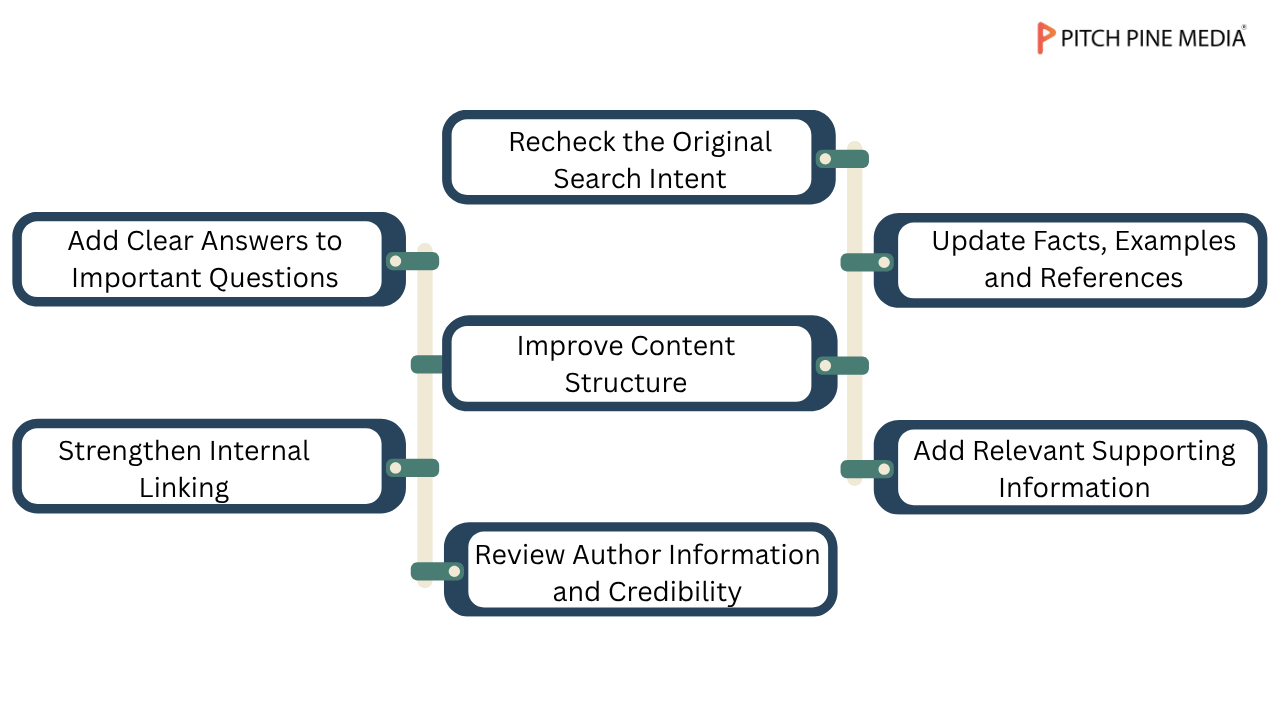
1. Recheck the Original Search Intent
Before changing anything, understand why the page was created.
Is it intended to explain a concept, compare options, answer a specific question or generate enquiries?
Then check whether the current content still meets that purpose.
For example, a blog about choosing an AI SEO agency should help readers compare services, understand the agency’s approach and identify what to evaluate before making a decision. Adding unrelated information about AI tools will not necessarily make it more useful.
Keep the original intent in focus while adding relevant information.
2. Add Clear Answers to Important Questions
AEO benefits from content that connects questions with direct, understandable answers.
Review the page and identify questions that readers may still have after reading it.
For example, an article about AI content optimization could answer:
After providing a direct answer, explain the topic with examples and supporting details.
Do not add questions simply to make the page look optimized for AI. Each question should address a genuine information gap.
3. Update Facts, Examples and References
Check every factual statement that may have changed since publication.
This includes:
- Industry statistics and research findings.
- Product and service details.
- Software features and platform capabilities.
- Legal or regulatory information.
- Pricing and market information.
- Examples and case studies.
Use reliable sources for factual updates. Where possible, include the source and date for important statistics.
Avoid adding unsupported claims about how AI platforms select citations. Their systems differ, and the exact selection process is not fully public.
4. Improve Content Structure
Long paragraphs and unclear headings make information harder to navigate.
Organize the page so that each section covers one main idea.
Useful improvements include:
- Descriptive H2 and H3 headings.
- Short paragraphs that explain one point at a time.
- Bullets for steps, features and comparisons.
- Tables when readers need to compare information.
- Definitions for technical terms.
- Relevant FAQs at the end of the article.
A clear structure helps readers locate information and gives search systems useful context about the page.
5. Strengthen Internal Linking
Internal links connect related information across your website.
For example, an article about AI content refresh can link to supporting resources about AI SEO, AEO, GEO and content optimization.
Use descriptive anchor text that tells readers what they will find on the linked page. Avoid inserting links simply to increase their number.
For example, a page discussing answer-focused content can naturally link to How Does AI SEO Work for AEO, GEO and AI Search?.
Similarly, a discussion about generative search can point readers towards Generative Engine Optimization Services for Growing Businesses.
The linked pages should add useful context rather than repeat the same information.
6. Add Relevant Supporting Information
Sometimes a page needs more than minor edits.
You may need to add a new section explaining a recent development, answer a missing question or include a practical example.
For instance, a blog about content optimization could benefit from a section explaining how businesses can monitor AI search mentions and citations.
The new information should fit the main subject. Avoid adding unrelated sections just to increase word count.
7. Review Author Information and Credibility
Readers should be able to understand who is responsible for the information on a website.
Where relevant, include accurate author details, professional experience, editorial information and references.
For business content, make sure company details and service descriptions are consistent across relevant pages.
These steps support transparency and help readers assess the information. They do not guarantee AI citations, but they contribute to a more credible website experience.
How AEO and GEO Fit Into an AI Content Refresh Strategy
AI Content Refresh should work alongside SEO, AEO and GEO rather than replacing them.
Answer Engine Optimization (AEO)
AEO focuses on making content useful for search experiences that provide direct answers to questions.
During a refresh, review whether the page:
- Answers its main question clearly.
- Uses headings that describe the information accurately.
- Explains technical terms.
- Includes relevant follow-up questions.
- Provides concise answers supported by useful detail.
- Uses appropriate structured data where relevant.
Businesses exploring Answer Engine Optimization Services in India should consider how existing pages can be improved before investing all their resources in new content.
Learn more about AEO, SEO and GEO and how they differ.
Generative Engine Optimization (GEO)
GEO focuses on improving how a brand and its information can be understood and represented in generative AI experiences.
A GEO-focused content refresh may involve:
- Making brand and service descriptions clearer.
- Updating supporting information about products and services.
- Improving topic coverage across related pages.
- Adding relevant evidence and references.
- Strengthening connections between important website resources.
- Checking whether the content explains the subject with sufficient context.
For a broader understanding, read Generative Engine Optimization Services for Growing Businesses.
Neither AEO nor GEO offers a guaranteed way to secure citations. The objective is to create accurate, useful and accessible information that can serve both people and search systems.
How Often Should You Refresh Website Content?
There is no fixed schedule that works for every website. The frequency depends on the subject, industry, page purpose and how quickly the information changes.
A practical review schedule could look like this:
| Content type | Suggested review frequency |
| Technology and AI-related blogs | Every 3–6 months |
| Industry research and statistics | When new reliable data becomes available |
| Service pages | Whenever services or processes change |
| Product pages | When product details or specifications change |
| Evergreen educational guides | Every 6–12 months |
| Pricing and policy information | Whenever details change |
These are planning guidelines, not ranking requirements. A page should be updated when there is a meaningful reason to improve it.
How to Measure the Results of AI Content Refresh
A content refresh should be evaluated using more than one metric. Traditional SEO performance remains important, while AI search visibility can provide additional insight.
Track the following:
- Organic impressions and clicks: Use Google Search Console to see whether the refreshed page is appearing for relevant searches and attracting visitors.
- Query coverage: Review whether the page is receiving impressions for more relevant long-tail and question-based searches.
- Search rankings: Monitor important queries, but avoid treating a single ranking change as proof that the refresh succeeded or failed.
- AI citations and mentions: Test relevant questions across AI platforms and record whether your brand or page appears as a cited source. Results may vary by platform, query and time.
- Referral traffic: Use analytics tools to identify visits arriving from AI platforms where referral information is available.
- Engagement and conversions: Check whether visitors explore related pages, submit enquiries or complete other meaningful actions.
- Content accuracy: Review whether the changes have corrected outdated information and filled the gaps identified during the audit.
For a wider measurement framework, read How to Measure AI SEO Performance Beyond Traditional Google Rankings.
Common AI Content Refresh Mistakes to Avoid
Updating content without a clear purpose can create more problems than it solves.
Avoid these common mistakes:
- Changing only the publication date: A new date does not make outdated information accurate or useful.
- Adding keywords unnecessarily: Repeating AI-related terms does not improve the quality of an article.
- Expanding content without adding value: More words are not always better. Every section should serve the reader.
- Removing useful information: Do not delete accurate explanations simply because they are older.
- Adding unsupported claims: Avoid promising guaranteed AI citations, rankings or visibility.
- Ignoring technical problems: Check indexing, crawlability, broken links and page accessibility where relevant.
- Refreshing every page at once: Prioritise pages based on performance, importance and the value of the potential improvements.
A careful refresh should make the page more helpful, not just different.
How Can an AI SEO Agency Help With AI Content Refresh?
Managing a large website can make content maintenance difficult. Businesses may have hundreds of blogs, service pages and landing pages that need different types of attention.
An experienced AI SEO Agency can help identify which pages need updates and develop a practical optimization plan.
The process may include:
- Content audit: Review existing pages for outdated information, content gaps and performance issues.
- Search intent analysis: Identify the questions and queries relevant to each page.
- Content gap research: Compare the existing information with what readers need to know.
- AEO improvements: Structure important sections around clear questions and answers.
- GEO improvements: Strengthen topical context, brand information and supporting evidence.
- Technical review: Check indexing, internal links, structured data and accessibility.
- Performance monitoring: Track organic visibility, AI mentions, referral traffic and conversions.
At Pitch Pine Media, an integrated approach to SEO, AEO and GEO can help businesses maintain their existing content while building resources around new search behaviour.
Businesses can explore AI SEO services by Pitch Pine Media to understand how content optimization fits into a wider AI search strategy.
Final Thoughts
Website content needs regular attention. Publishing a page once and leaving it unchanged can allow useful information to become outdated, incomplete or disconnected from what readers are searching for.
AI Content Refresh provides a structured way to improve existing resources. It involves checking accuracy, understanding current search intent, adding missing information, improving content structure and connecting related pages.
For businesses working towards better visibility in AI-powered search, this process should be part of an ongoing content strategy. SEO provides the foundation, AEO helps make answers clearer, and GEO focuses on how brands and their information are understood in generative search experiences.
The priority should remain simple: maintain content that answers real questions, communicates accurate information and gives readers a reason to trust the source.