

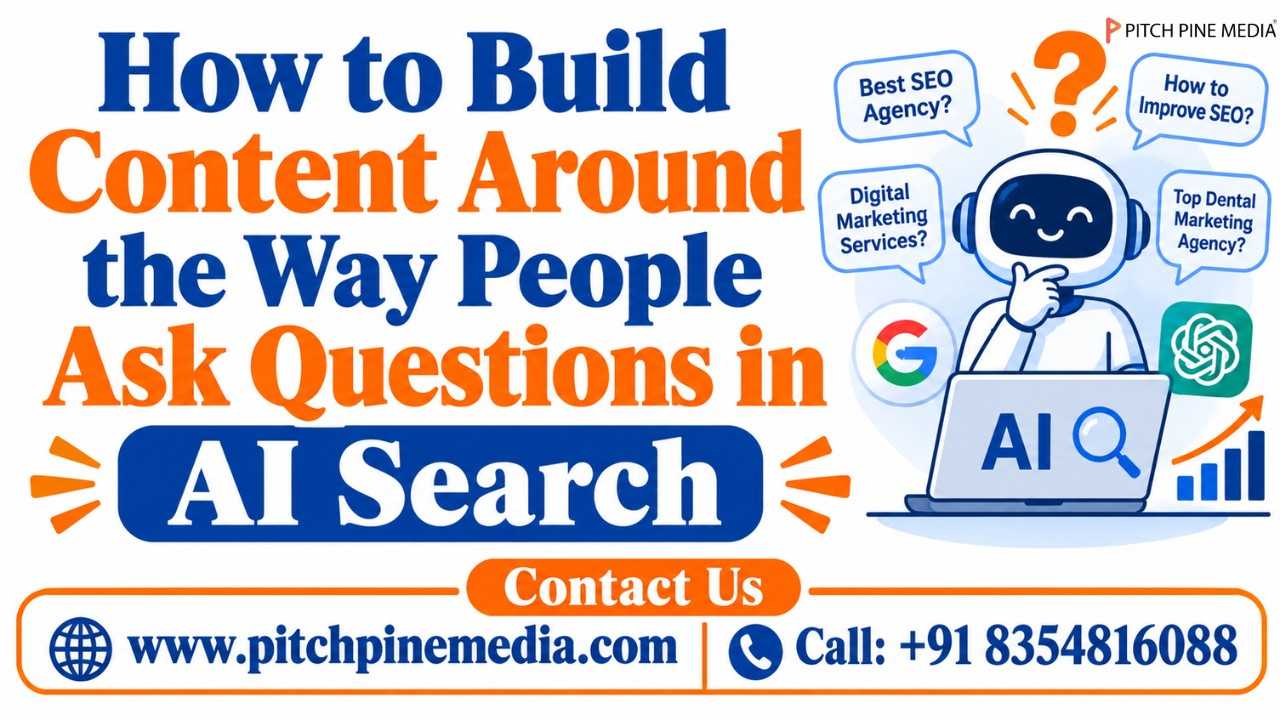
Search behaviour is changing. People are no longer relying only on short keywords to find information. They are asking complete questions, explaining their situations and expecting answers that address their specific needs.
For example, someone looking for an SEO agency might search for “AI SEO Agency in India.” But they may also ask ChatGPT or Google AI, “Which AI SEO agency in India can help my business get more visibility in ChatGPT and Google search?”
Both searches relate to the same service, but the second one reveals much more about the user’s expectations.
This shift makes Conversational Query Optimization an important part of modern content strategy. Instead of creating pages around isolated keywords, businesses need content that reflects how their audiences naturally ask questions.
For brands investing in SEO, Answer Engine Optimization (AEO) and Generative Engine Optimization (GEO), this means understanding search intent at a deeper level. Content should answer real questions, explain relevant details and help users move towards an informed decision.
What Is Conversational Query Optimization?
Conversational Query Optimization is the process of planning and improving website content around the natural-language questions people use when searching for information, products or services.
Traditional keyword research often focuses on short phrases such as:
- AI SEO services
- Digital marketing agency
- Technical SEO
- Content marketing
- Local SEO company
Conversational searches are usually more detailed:
- How can an AI SEO agency improve my website’s visibility?
- What should I look for before hiring a digital marketing agency?
- How does technical SEO affect website rankings?
- Which content strategy can help my business appear in AI search results?
The goal is not to insert every possible question into a blog. It is to understand what people want to know and provide a useful answer in the right context.
Why Are Conversational Queries Important in AI Search?
AI-assisted search experiences have transformed the way people find information. Tools like ChatGPT, Gemini and Perplexity let users ask comprehensive questions and dive into related queries during the same conversation.
Let’s say that there is someone who wants to enhance the organic reach of their website. It will look something like this:
- What is AI SEO?
- How is AI SEO different from SEO?
- Will AI SEO make me rank on ChatGPT?
- How expensive is the implementation of AI SEO?
- Who can do SEO, AEO and GEO together for me?
Every question marks one particular phase of the decision-making process. A single piece of content targeting the keyword “AI SEO” may not cover all of them.
In case of the exploration of Answer Engine Optimization Services in India, conversational content becomes a valuable tool.
How to Find the Questions Your Audience Is Actually Asking
The first step is understanding your audience’s search behaviour. Content should not be based only on assumptions about what people might search for.
Use different sources to identify real questions and recurring concerns.
1. Start With Keyword Research
Keyword research is still relevant, but one needs to look not only at the volume and the level of competition.
Identify long-tail keywords, question phrases, and search terms. They will give you a hint about what users are looking for in order to make a choice.
For example, a business providing SEO services can ask the following questions:
- How does SEO work for small businesses?
- How much time does SEO take to give results?
- What is the difference between SEO and AEO?
- Is there a way to increase SEO visibility in the AI search?
- How to select an SEO agency for my business?
Categorize these questions by intent and decide which of them requires a thorough blog post and which can fit into the service or FAQ page.
2. Study Google’s People Also Ask and Related Searches
Google’s People Also Ask section can help identify questions connected to a particular topic.
For example, searching for “Generative Engine Optimization” may reveal questions about how GEO works, how it differs from SEO and whether businesses need it. Related searches can also highlight variations in the way people describe the same problem.
3. Review Sales and Customer Support Questions
Questions from existing customers and sales enquiries are valuable sources of content ideas.
Look at the concerns people raise before purchasing a service. Common questions may include:
- How much does the service cost?
- What is included in the package?
- How long will it take to see improvements?
- Will this work for my industry?
- Do I need to change my existing website?
These questions often have commercial intent. Answering them on relevant service pages can help users make decisions with greater confidence.
How to Turn Conversational Questions Into Useful Content
Finding questions is only the beginning. The next step is organizing them into content that provides complete and relevant answers.
1. Identify the Search Intent Behind Each Question
Two queries may discuss the same subject but require different content.
For example:
| Conversational query | Search intent | Suitable content |
| What is AEO in digital marketing? | Informational | Educational blog |
| How does AEO improve AI search visibility? | Informational | Detailed guide |
| Which AEO agency should I hire in India? | Commercial | Service or comparison page |
| How much do AEO services cost? | Commercial investigation | Pricing guide or service FAQ |
| Can AEO work with traditional SEO? | Informational | Supporting blog |
A person looking for a definition needs a clear explanation. Someone comparing agencies needs information about services, expertise, processes and relevant experience.
2. Use Question-Based Headings
Headings should reflect the questions people are likely to ask.
Instead of using a generic heading such as “Benefits of AEO”, consider:
- How Can AEO Improve Your Website’s Visibility?
- What Makes Content Useful for AI Search?
- How Does AEO Differ From Traditional SEO?
Question-based headings make the subject of each section clear. They also help readers find relevant information without going through the entire article.
3. Give a Direct Answer Before Adding Details
A useful approach is to answer the main question in the opening lines of a section.
For example:
Question: What is Conversational Query Optimization?
Conversational Query Optimization means creating and structuring content around the natural-language questions people use in search engines and AI-powered platforms. It focuses on understanding search intent and providing clear, relevant answers.
After the direct answer, explain how the process works, why it matters and what businesses can do to apply it.
This structure supports readability and makes important information easier to identify. It is also useful for AEO because the question and its answer are clearly connected.
4. Cover Follow-Up Questions Naturally
People rarely stop after receiving one answer. They often ask another question to understand the subject better.
For example, someone searching for AI SEO may continue with:
- How does AI SEO work?
- Is AI SEO different from AEO?
- Does GEO improve brand visibility?
- Can small businesses benefit from AI search optimization?
Your content should anticipate relevant follow-up questions without becoming repetitive.
A detailed article can explain the main concept, while related blogs can explore specific areas in greater depth. Internal links should connect these pages so readers can continue learning.
For a broader explanation, read How Does AI SEO Work for AEO, GEO and AI Search?.
How AEO and GEO Support Conversational Content
Conversational content is closely tied to both Answer Engine Optimization and Generative Engine Optimization. The two are not the same thing, though. Each one has its own focus, so let’s take them one at a time.
Answer Engine Optimization (AEO)
AEO is about making your information clear and useful for platforms that give people direct answers. In practice, that means doing a few things well:
- Find the questions people really ask about your business.
- Answer them in plain language, without jargon.
- Use descriptive headings so each answer is easy to spot.
- Add FAQs to your service pages and blog posts.
- Use structured data where it makes sense.
- Back your answers with accurate details, not vague claims.
Here’s an example. Say you run a dental clinic. A page about dental implants is a good start, but it isn’t enough. Patients also want quick answers to questions like “How long does a dental implant procedure take?” and “Who is a good candidate for dental implants?” These are the exact doubts people have before they book, so answering them clearly can be the push that gets someone to call.
If you want to see how question based content and page structure fit into a bigger search plan, take a look at our Answer Engine Optimization Services in India.
Generative Engine Optimization (GEO)
GEO focuses on improving how a brand and its information can be understood and represented in generative AI search experiences. A user might ask: “Which digital marketing agency can help an eCommerce business improve its visibility in Google and AI search?”
To be relevant to such a question, a business needs more than a page containing the phrase “digital marketing agency.” Its website should clearly explain its services, expertise, industries, experience and the problems it solves.
A strong GEO content strategy includes:
- Detailed and accurate information about the brand.
- Consistent descriptions of services and expertise.
- Supporting content around important industry topics.
- Clear explanations backed by relevant evidence.
- Natural internal links between related pages.
- Credible information across the wider digital presence.
Read Branded GEO: Control Your Brand’s Visibility in AI Search for more information about brand representation in AI-powered search.
Build Topic Clusters Around Conversational Queries
Publishing individual blogs for unrelated questions can create a disconnected website. A better approach is to organize content into topic clusters. A topic cluster includes one main page supported by related articles that cover specific aspects of the subject.
For example, a business focusing on AI search optimization could build a content cluster like this:
| Main topic | Supporting content ideas |
| AI SEO | How AI SEO works, AI SEO benefits, AI SEO strategy |
| AEO | Common questions in search, direct-answer content, FAQ optimization |
| GEO | Brand visibility in AI search, entity clarity, generative search |
| Conversational search | Natural-language queries, voice search, question-based content |
| Technical SEO | Website structure, indexing, schema markup, crawlability |
The main page should provide a useful overview and link to relevant supporting articles. Each supporting article should link back to the main topic where appropriate.
For a practical comparison of these approaches, see AEO vs SEO vs GEO: What Should Indian Businesses Focus On?.
Common Mistakes to Avoid When Creating Conversational Content
A question-based content strategy can become ineffective when businesses focus more on formatting than on answering the user’s actual concern.
Watch out for these mistakes:
- Adding questions without useful answers: A page filled with question headings does not automatically become helpful. Each question should receive a relevant, complete response.
- Repeating the same keyword in every section: Natural language includes variations. Use related terms where they fit instead of forcing the exact keyword into every paragraph.
- Creating separate pages for nearly identical queries: Multiple pages targeting minor variations of the same question can lead to repetitive content. Combine closely related questions when one detailed page can answer them effectively.
- Ignoring commercial intent: Informational content is important, but businesses should also address pricing, services, processes and buying concerns where relevant.
- Forgetting internal links: Related pages should connect naturally. A blog about conversational search can link to relevant AEO, GEO and AI SEO service pages without forcing promotional references.
How to Measure the Performance of Conversational Content
Conversational content needs to be measured using the traditional SEO metrics, as well as metrics associated with the visibility of AI search engines.
Useful metrics include:
- Organic impressions: Determine if your pages show up for a greater variety of searches in Google Search Console.
- Organic clicks: Determine the number of people who come to your website through organic searches.
- Variations in search queries: Look at the actual questions that users are asking and taking them to your pages.
- Engagement: Analyze if the visitors are looking into more related content on your website.
AI responses may vary depending on the search query, platform, and context. As such, the mention of a particular brand during the testing process does not imply ongoing visibility.
How Can an AI SEO Agency Help With Conversational Query Optimization?
Building content around conversational searches requires research, planning and ongoing optimization. An experienced AI SEO Agency can help businesses connect keyword research with audience questions, search intent and content development.
A structured approach may include:
- Search intent mapping: Group queries into informational, commercial and transactional categories.
- Content planning: Decide which questions belong in blogs, service pages, FAQs or supporting resources.
- AEO optimization: Improve content structure and provide direct answers to relevant questions.
- GEO strategy: Strengthen brand information, topical coverage and the clarity of business expertise.
- Technical SEO: Review crawlability, indexing, page structure and relevant structured data.
- Performance monitoring: Track search visibility, engagement, enquiries and available AI referral data.
At Pitch Pine Media, these activities can be considered together rather than treating SEO, AEO and GEO as completely separate strategies.
Businesses looking for an integrated approach can explore AI SEO services by Pitch Pine Media. The right strategy depends on the website, industry, target audience and the questions potential customers are trying to answer.
Final Thoughts
The way people search is becoming more conversational. They explain their problems, add context and ask follow-up questions instead of relying only on short keywords.
Businesses need to reflect this behaviour in their content. That means understanding the questions customers ask, identifying the intent behind them and providing answers that are clear, accurate and genuinely useful.
Conversational Query Optimization should work alongside traditional SEO, AEO and GEO. It is not about turning every heading into a question or writing content specifically to attract AI-generated answers. It is about making information easier for people to find, understand and use.
A website that answers relevant questions, connects related topics and communicates its expertise clearly is better prepared for changing search experiences.