

Your rankings change because Google keeps re-checking pages, competitors keep improving theirs, and what people search for keeps shifting. A drop doesn’t mean your SEO has failed. It means something changed, and the fix starts with finding out what. Below, you’ll find why rankings move, which factors matter most, and how to build steady growth with the help of an SEO Company in India or your own team.
You were on page one last week. This week you’ve slipped a few spots. Maybe your organic traffic is down, your key service pages aren’t getting clicks, or a competitor now sits above you for the searches that bring in customers. It’s stressful, and it can feel personal.
It isn’t. Even well optimized websites go up and down. Competitors improve their content, search intent changes, technical problems creep in, and Google keeps adjusting its systems. The real question is what caused your change, and what to do about it.
In this guide, we’ll cover why rankings fluctuate, which ranking factors matter, and how to improve your SEO rankings for lasting growth.
What Causes Google Rankings to Fluctuate?
Google doesn’t give your website a permanent spot. It looks at each page one search at a time and decides which results fit that search best. So your position can move even when you haven’t touched anything.
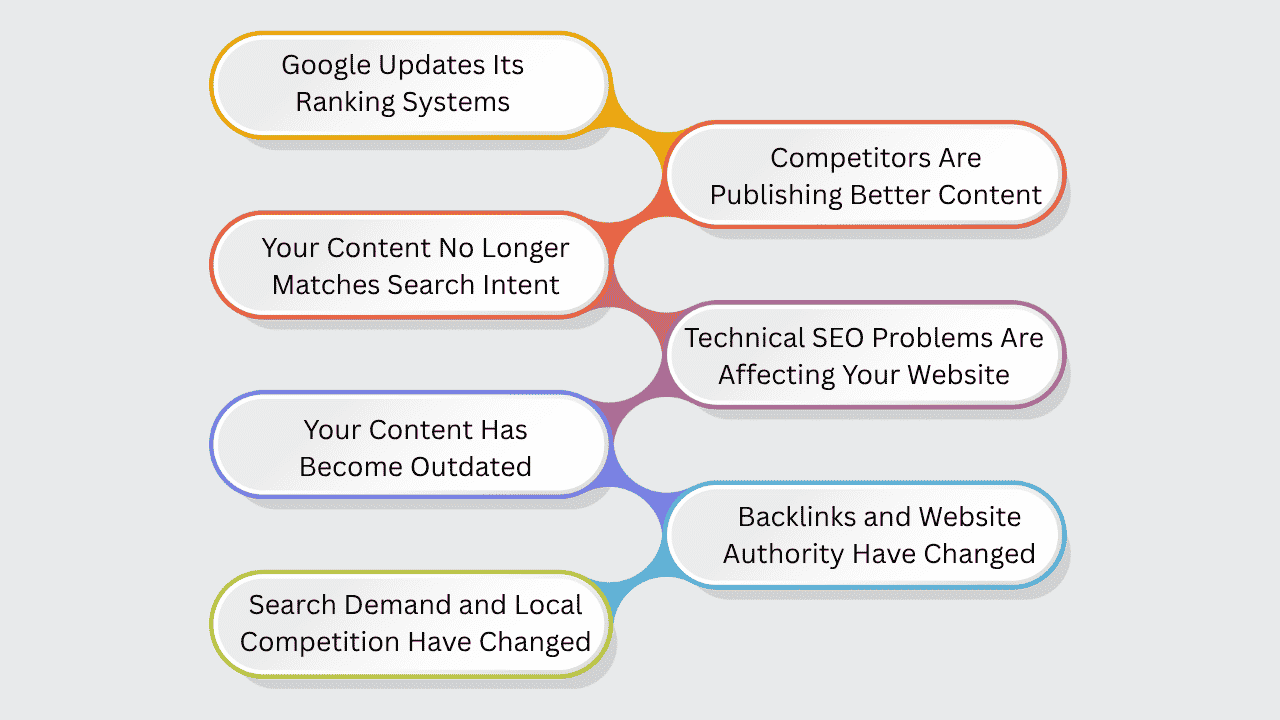
Rankings usually shift for five reasons: Google updates its algorithm, competitors improve their pages, your content gets old, a technical problem appears, or people start searching in a different way. Sometimes the drop is small and fixes itself in a few days. Other times it’s a warning that something on your site needs work.
So before you change anything, work out why it moved. Once you know the cause, you know what to fix.
1. Google Updates Its Ranking Systems
Google updates how it ranks pages all the time, and it does this to make results more useful. The big ones, called core updates, can shake up sites in almost every industry, even sites that haven’t changed a single page.
What to do: First, check Google’s Search Status Dashboard to see if an update was confirmed. Then open Search Console and find out which pages and searches lost visibility. Next, search for those terms yourself and compare the top results with your page. Ask what they do that you don’t.
2. Competitors Are Publishing Better Content
You’re not only up against Google’s algorithm. You’re up against other pages that want the same spot. A competitor may write more helpful content, improve their service pages, earn good backlinks, or cover a topic more fully than you do.
Here’s a common case. A competitor passes you because their page answers a customer’s question more clearly, or because it includes something yours leaves out.
If you sell in competitive markets across several countries, it helps to work with the Best SEO Agency for Global Businesses, one that understands how people search in different places and how to research competitors in each market.
Our team offers global SEO services for businesses that want to reach customers in different countries. Take a look to see how we handle international search.
3. Your Content No Longer Matches Search Intent
Search intent is simply what a person wants when they type something into Google. Someone who searches “what is technical SEO” wants an explanation. Someone who searches “technical SEO services” is probably comparing companies to hire.
How to fix it:
- Search your target keyword and look at what’s ranking right now.
- Work out what people expect to see: a guide, a comparison, a product page, or a service page.
- Put the main answer near the top of your page.
- Add related questions that really help the reader.
- Cut anything that doesn’t serve the purpose of the page.
4. Technical SEO Problems Are Affecting Your Website
If Google can’t crawl, index, or understand your pages, even great content won’t show up. That’s why a technical problem can quietly hold back a good site.
These are the usual causes:
- Broken links
- Wrong canonical tags
- A noindex tag left on by mistake
- Redirect errors
- Slow loading pages
- Duplicate URLs
If you find problems you can’t fix yourself, our Technical SEO Services can help.
5. Your Content Has Become Outdated
Content that performed well in the past may no longer answer the questions users are asking today. Statistics become outdated, industry practices change, and competitors may publish more complete information. These changes can reduce the usefulness of an existing page.
Do not update content simply to change its publication date. Focus on making it more accurate, relevant, and useful.
6. Backlinks and Website Authority Have Changed
Backlinks are links from other websites to your content. Relevant links from trustworthy websites can help search engines discover pages and understand their reputation. However, more backlinks do not automatically mean better rankings. Relevance and quality matter, and ranking changes should not automatically be blamed on lost links.
7. Search Demand and Local Competition Have Changed
Search demand can fluctuate because of seasonal trends, changing customer needs, and differences in how people search. Local businesses may also experience ranking changes when competitors improve their Google Business Profiles, collect new reviews, or strengthen their local website content.
We offer Local SEO Services in India for businesses looking to improve their local search presence.
Why do Google rankings change every day?
Rankings move because Google is always re-checking pages, your competitors keep updating their sites, and what people search for keeps shifting. What you see also depends on where you are, which device you’re using, your language, and how the search is worded. Two people can search the same thing and see slightly different results.
To tell the difference, open Google Search Console and compare clicks, impressions, and average position across two similar periods, like this week against last week, or this month against the same month last year. If the numbers dip a little and bounce back, it’s normal movement. If they keep falling, something needs fixing.
How long does it take to improve Google rankings?
Most SEO work takes a few weeks to a few months to show results. The exact time depends on where your site stands today, how tough your competition is, how healthy your site is technically, how good your content is, and what changes you make.
Some fixes can show up fast. If you clear a technical problem, Google may pick up the change as soon as it crawls your site again. But competitive keywords usually take much longer, because you’re up against pages that have had years to build trust.
So don’t expect results overnight. Watch the signs that show real progress: more clicks from search, more impressions, rising visibility for your target keywords, and more calls or enquiries. If those numbers are moving up, the work is paying off, even before you reach page one.
What causes a sudden drop in Google rankings?
A sudden drop usually comes from one of six things: a Google update, a technical error, an indexing problem, lost backlinks from good sites, a competitor getting stronger, or a change in what people want when they search.
To narrow it down, check how far the drop goes. Did your whole site fall, or just a few pages? If many pages vanish from search results, look at crawling and indexing first, because Google may not be able to reach or store them. If only a few keywords dropped, look at those pages and see what the pages ranking above you are doing better.
Whatever you find, don’t change ten things at once. You won’t know which one worked. Pick the most likely cause, fix that first, and then watch what happens.
Why Is My Website Not Showing on Google?
If your website does not appear on Google, first check whether the affected pages are indexed.
A page may not appear because Google has not discovered it, cannot crawl it, has excluded it from indexing, or does not consider it relevant enough for the searches you are targeting.
Use the following table to identify possible issues and the steps you can take.
| Possible problem | How to identify it | Recommended action |
| Page is not indexed | Check the URL in Google Search Console | Investigate the reason and request indexing when appropriate |
| Accidental noindex tag | Review the page’s HTML or inspection report | Remove the directive if the page should be indexed |
| Crawling restrictions | Check robots.txt and Search Console reports | Correct unintended restrictions |
| Duplicate content | Review similar URLs and canonical tags | Consolidate duplicate or overlapping pages where appropriate |
| Poor content relevance | Compare the page with current search results | Improve content quality and alignment with search intent |
| Broken internal links | Crawl the website and review navigation | Fix broken links and connect important pages |
| Technical errors | Check server responses and redirects | Resolve errors that prevent access or indexing |
A site: search can provide a basic indication of indexed pages, but Google Search Console is more useful for diagnosing specific indexing problems.
What is the most important Google ranking factor?
There is no single ranking factor that determines every Google position. Rankings depend on several systems and signals that help Google understand relevance, usefulness, quality, and context.
Important areas to focus on include:
- Content quality: Provide accurate, helpful information that satisfies the search query.
- Search intent: Make sure the page matches what users want to find.
- Technical SEO: Help search engines crawl, render, and index your pages.
- Backlink quality: Earn relevant links that support your website’s reputation.
- Page experience: Make the website accessible, stable, and easy to use.
- Topical relevance: Build useful coverage around the subjects that matter to your audience.
The right priorities depend on your website and its current weaknesses. Improving the areas that create the biggest barriers is often more useful than making small changes everywhere.
How to Rank Higher on Google
Improving rankings requires a consistent approach to keyword research, content, technical optimization, and performance monitoring.
Here are eight practical steps to strengthen your SEO strategy.
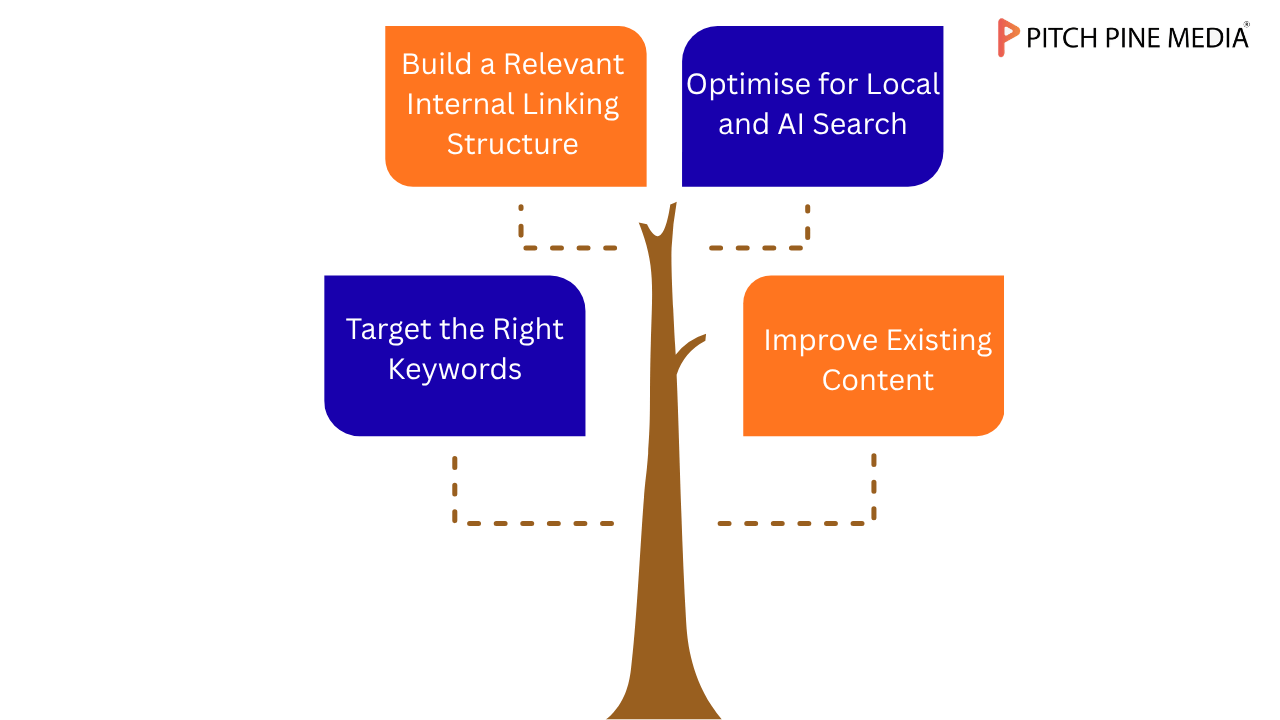
1. Target the Right Keywords
Choose keywords based on what your audience searches for and the services or information your business provides. Separate informational keywords from commercial and transactional keywords. Use them on pages that match their search intent.
For example, an SEO agency may create separate pages for technical SEO, local SEO, AI SEO, and content marketing rather than covering every service on one page. Include related terms naturally. Avoid keyword stuffing, which can make content difficult to read and reduce its usefulness.
2. Improve Existing Content
Before publishing more blogs, review the pages that already receive impressions or rank for relevant queries.
Identify missing information, weak headings, outdated details, and unanswered questions. Update the content where meaningful improvements are possible.
For a detailed guide, read our existing article, How to Rank Higher on Google: Proven SEO Strategies.
3. Build a Relevant Internal Linking Structure
Internal links connect related pages and help visitors discover more information. For example, a blog about ranking fluctuations can link to a technical SEO service page, an AI SEO guide, and an article about improving Google rankings. Use descriptive anchor text that explains what readers will find on the destination page.
Our AI SEO Agency in India page explains its approach to traditional SEO and AI search visibility. Readers can also explore the related article, How Does AI SEO Work for AEO, GEO and AI Search?.
These links support the topic and provide readers with additional resources without interrupting the flow of the blog.
4. Optimize for Local and AI Search
Classic SEO still matters. But more people now get answers from AI tools too, so your business should show up there as well.
For local search, start with the basics. Make sure your business details are correct everywhere, build strong pages for each location you serve, and keep your Google Business Profile complete and up to date.
For AI search, write content that answers the real questions your customers ask. Explain your services clearly and honestly, and show that you know your subject. AI tools tend to pick sources that are clear, specific, and trustworthy.
Want to see how this works in practice? Learn more about our AI SEO services.
Does updating old content improve rankings?
Yes, updating old content can improve rankings when the changes make a page more accurate, relevant, complete, and useful. It does not guarantee a ranking increase.
Start with pages that have lost organic clicks, receive impressions without enough clicks, or contain outdated information.
Update facts, answer missing questions, improve readability, and add relevant internal links. Keep the original purpose of the page clear.
Changing the publication date without making meaningful improvements is unlikely to provide the same value.
Can AI-generated content affect Google rankings?
Using AI to write isn’t against Google’s rules. Google cares about whether your content is good, useful, and trustworthy, not which tool made it.
The real risk is content made just to game the rankings. If you publish hundreds of thin pages with nothing original on them, you can get into trouble no matter who or what wrote them.
Used well, AI can help you with research, outlines, analysis, and editing. But always check the facts, add your own knowledge and real examples, and ask yourself one question before you publish: does this actually help the reader?
Want to know how AI fits into SEO? Pitch Pine Media’s AI SEO Agency in India page explains how we use AI to support both traditional search and AI powered discovery.
How often does Google update its algorithm?
Google changes its ranking systems all the time. Most changes are small and nobody hears about them. Now and then, a bigger one comes along, like a broad core update, and Google announces it publicly.
There’s no fixed schedule, so you can’t plan around a date.
If your rankings start moving, check Google’s Search Status Dashboard to see if an update was confirmed. Then look at your own performance data. Look for a pattern first, such as the same pages or the same type of search losing ground. Don’t blame an update until the data points that way, because many drops come from your own site or from competitors.
Improve Your SEO Rankings With Pitch Pine Media
Not every ranking change is a crisis. Some are just normal ups and downs. Others point to real problems: technical errors, old content, stronger competitors, or pages that don’t match what people are searching for. Either way, the right move is the same. Find the cause, fix what matters most, and keep an eye on the results over time.
At Pitch Pine Media, our team helps businesses grow their visibility through SEO strategy, technical fixes, content, and AI search optimization.
If you’re looking for an SEO Agency in India, choose a partner who understands your audience and your business goals, not just your keywords. And if you sell in more than one country, look for the Best SEO Agency for Global Businesses, one that knows how people search in different markets and can optimize for each location.
You can learn more about how we work on the Pitch Pine Media website, including our approach to search visibility and long term growth.