

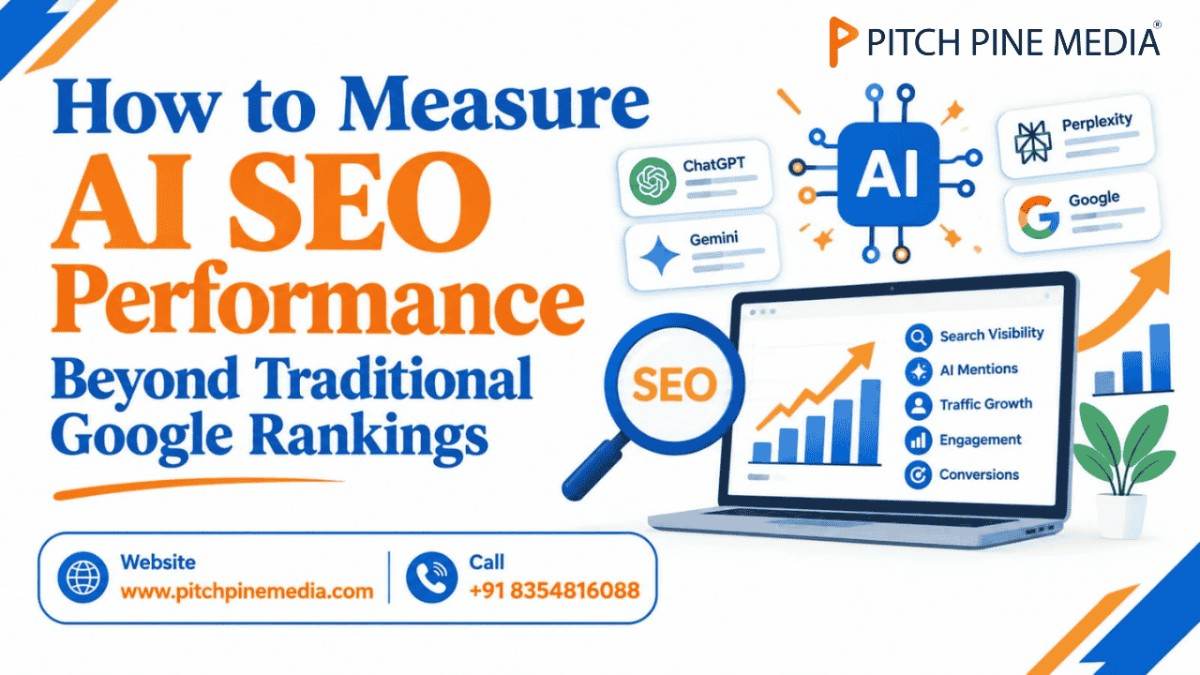
To measure AI SEO performance, track four things: how often AI tools mention or cite your brand, how much traffic arrives from AI platforms, how your branded search demand changes, and whether those visitors turn into leads. Rankings still matter, but they only show one part of your visibility.
For years, the monthly report was simple. You opened a rank tracker, saw your keyword at position three, and called it a win. Then people started asking ChatGPT, Gemini, and Perplexity their questions, and Google began placing AI generated answers above the usual results. Now a customer can learn about your brand, compare it with two others, and make a decision without clicking a single blue link.
If your report still shows only rankings, it is missing a lot. This guide explains what to measure instead, how to set it up step by step, and what a useful report looks like. It comes from the work we do every day as an AI SEO agency in India, serving clients across India, the US, and Europe.
Why Rankings Alone Fall Short
A ranking tells you where a page sits on a results page. That is useful, but it leaves out several things you need to know:
- Whether an AI tool named your brand in its answer
- Whether your page was used as a source
- Whether a person read a summary of your content and never visited your site
- Whether that exposure led to a call, a form fill, or a sale
- Whether the AI described your business correctly
There is another problem. AI answers are not fixed. Ask the same question twice and you can get two different responses, with different brands and different sources. That means you cannot treat one check as the truth. Good measurement looks at patterns across many questions over several weeks.
The Metrics That Matter in AI Search
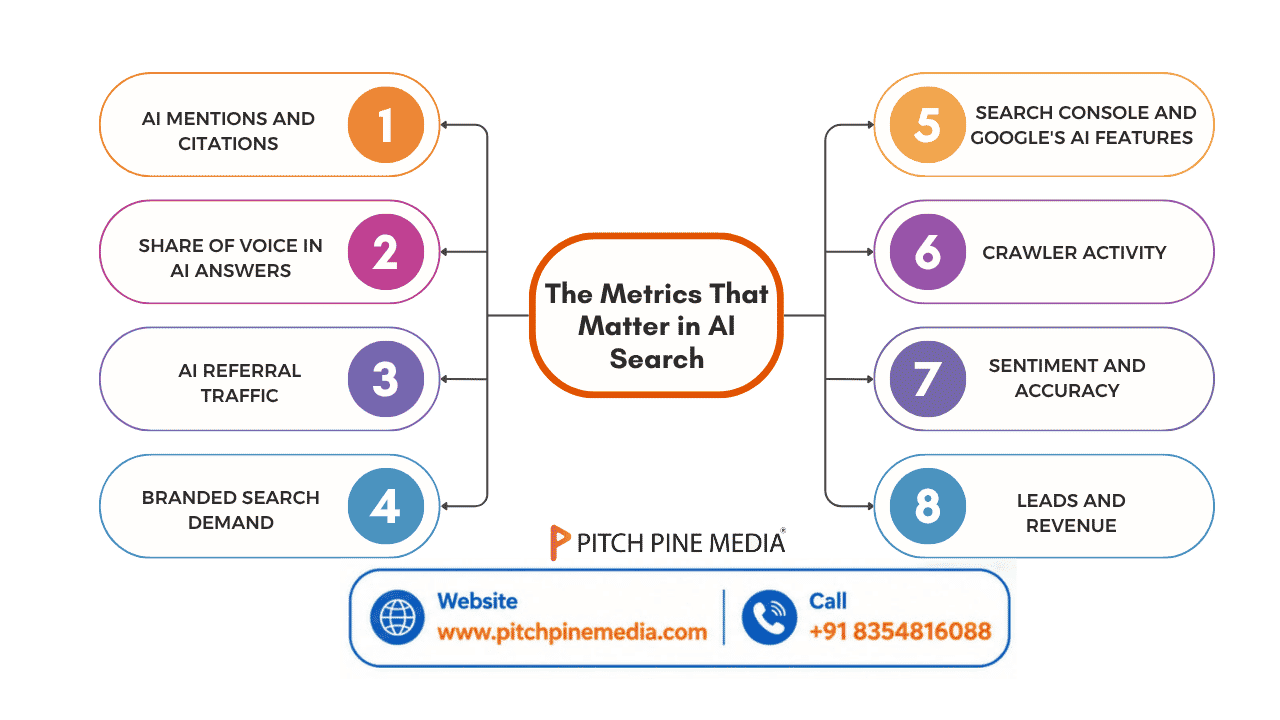
1. AI mentions and citations
This is the key metric. An AI mention is when an AI solution cites your brand name as part of the answer. An AI citation is when the page on which your brand is mentioned gets linked to by the AI tool. These two metrics cannot be used interchangeably.
An AI tool can mention your brand name but provide no link to it at all, and it can cite your page but make no mentions of your brand name.
2. Share of voice in AI answers
What share of your questions does your brand show up in compared to one or two others based on the same questions?
For instance, when you ask 40 questions and your brand appears in 6, then your share of voice will be 15 percent while your competitor who appears in 20 will have 50 percent share of voice. This is where your attention should lie. A jump from 15 percent to 30 percent in a matter of months is an obvious indication.
3. AI referral traffic
Certain AI applications refer visitors to your website. Within Google Analytics 4, you can examine the referral traffic from platforms like chatgpt.com, perplexity.ai, gemini.google.com, and copilot.microsoft.com.
For better visibility, create a channel group within Google Analytics 4 named “AI Search” with a regex pattern matching these referral sources. While the volume is currently quite low, this type of traffic is generally very intent-driven. Visitors coming from an AI answer have most likely researched their question to some extent.
4. Branded search demand
When AI tools recommend you, people often search for your name afterward. Watch branded impressions and clicks in Google Search Console. Also look at direct traffic in GA4.
A steady rise in both can be a sign that AI visibility is working, even when clicks from AI platforms are low. This is one of the most overlooked signals, because the benefit shows up in a different channel from where it started.
5. Search Console and Google’s AI features
Google tracks the impressions and clicks received via the AI-powered features in the aggregate metrics of Search Console. It does not provide a separate report for this type of traffic, thus, there is no way to separate it directly.
However, one can observe the trends. One may check whether impressions go up with the question-based queries. Whether the click-through rate changes on the pages that are answering the questions. The pages, which receive more impressions and less clicks, could be summarized in the AI-powered answers.
6. Crawler activity
AI technology can only cite what is available to it. Verify whether your server logs have any AI crawlers visiting your website like GPTBot, OAI-SearchBot, PerplexityBot, and ClaudeBot. If they never get to your important web pages, then resolve that issue first.
Also, check your robots.txt file for any rule written a while back that may be preventing bots from accessing your site even if you wish them to.
7. Sentiment and accuracy
Just being referenced is not enough. See for yourself how AI talks about your business.
- Does it represent your services in the right way?
- Do your location, prices, and unique advantages fit the description?
- Is the tone of voice positive, neutral, or negative?
- Does it mistake you for someone else?
Inaccurate content from AI is a problem you may face, but it can be easily solved as soon as you identify it. In most cases, all you have to do is to change your website and improve your profiles on trusted third-party websites.
8. Leads and revenue
This is where the work pays off. Ask new leads how they found you. Add “ChatGPT or another AI tool” as an option on your forms. Compare conversion rates from AI referrals with other channels, and review lead quality, not just volume.
Small businesses in particular benefit from tying visibility directly to enquiries. Our guide on How Small Businesses Can Generate More Leads with AI SEO shows how to connect the two.
Quick Reference Table
| Metric | Where to find it | What it tells you |
| AI mentions and citations | Manual prompt testing or tracking tools | Whether AI knows and trusts your brand |
| Share of voice | Your prompt log | How you compare with competitors |
| AI referral traffic | GA4 | Visits from AI platforms |
| Branded search | Search Console | Growing awareness |
| Crawler visits | Server logs | Whether AI bots can reach your content |
| Accuracy and sentiment | Manual review | Whether your brand is described correctly |
| Leads from AI | Forms, CRM, call tracking | Business impact |
How to Build Your Prompt List
The quality of your measurement depends on the quality of your questions. A weak list gives you weak data. Here is how to build a strong one.
Start with real customer questions. Look at sales calls, emails, chat logs, and the questions your team hears every week. Use the exact wording customers use, not marketing language.
Cover the full journey. Include three types of questions:
- Learning questions: “What is white label SEO?”
- Comparing questions: “What should I look for in an SEO partner?”
- Buying questions: “Which agency can handle SEO for my clients?”
Add your location and audience. Questions with a place or a group in them, like “for small businesses in India,” often trigger more specific answers.
Keep it to 30 to 50 questions. That is enough to see patterns without turning measurement into a full time job.
Do not change the list every month. If you swap questions often, you cannot compare results over time. Add new questions in batches and keep the core list stable.
A Simple Measurement Framework
You do not need expensive tools to begin. Follow these steps:
- Set a baseline. Test your question list today and record the results.
- Choose your platforms. Pick three or four AI tools your audience actually uses.
- Test on a schedule. Repeat monthly, and run each question two or three times since answers vary.
- Track in one sheet. Log mentions, citations, competitors, and accuracy.
- Connect to analytics. Match AI visibility with GA4 and Search Console trends.
- Review quarterly. Look for movement and decide what to fix or expand.
What a Good AI SEO Report Looks Like
A useful report is short and clear. It should help you make a decision, not drown you in charts. Here is a layout that works well:
Page 1: Summary. Three to five sentences on what changed this month and why it matters.
Page 2: Visibility. Mentions, citations, and share of voice compared with last month and your baseline.
Page 3: Traffic and demand. AI referral visits, branded search trends, and direct traffic.
Page 4: Business results. Leads, calls, and sales that came from AI sources or were influenced by them.
Page 5: Issues and fixes. Wrong information found, pages that need work, and technical problems.
Page 6: Next steps. Three actions for the coming month.
If you work with an agency, ask for a report that follows a structure like this. If you run an agency yourself, white label reports in this format help your clients see the value of the work.
A 90 Day Plan to Get Started
If you are starting from zero, here is a realistic timeline.
Days 1 to 30: Set up. Build your prompt list, run your baseline test, create the GA4 channel group, check crawler access, and fix any accuracy problems you find.
Days 31 to 60: Improve and watch. Update or create content for questions where you are missing. Make sure each page answers a specific question clearly near the top. Run your second round of tests.
Days 61 to 90: Compare and decide. Run a third round, compare against the baseline, and review traffic and lead data. Decide which topics deserve more investment.
Results will vary by industry, competition, and how strong your site already is. Be wary of anyone who guarantees a specific outcome. Nobody outside the AI companies controls exactly what these tools say.
Common Mistakes to Avoid
- Relying on one test. AI answers shift, so a single check can mislead you.
- Ignoring Bing. Several AI tools draw on Bing’s index, so check Bing Webmaster Tools too.
- Only counting clicks. In AI search, a mention without a click still has value.
- Skipping the basics. Strong technical SEO, clear headings, and direct answers support everything above.
- Tracking too many things. Pick the metrics that match your goals and stick with them.
- Never reading the answers. Numbers matter, but reading the actual AI responses shows you what your customers see.
What to Ask When Choosing a Partner
If you hire help, ask how they report. A good partner will show you mentions, citations, share of voice, and leads, not only keyword positions. They should also explain their methods in plain language and be honest about what they cannot control.
For a full checklist, read How to Choose the Right AI SEO Agency in India. If you work with clients outside India, our page on the Best AI SEO Agency in India for Global Businesses explains how we support international markets across different time zones and search habits.
To understand the thinking behind these metrics, see How Does AI SEO Work for AEO, GEO and AI Search? It covers how answer engines pick sources, which shapes what you should measure. You can also explore our Answer Engine Optimization and LLM SEO services for more detail on each area.
How Pitch Pine Media Helps
Pitch Pine Media is an ISO 9001:2015 certified agency with offices in India, the US, and Germany and a team of over 100 specialists. We handle AI visibility work for brands directly and also as a white label partner for other agencies, with reports under your own branding.
Curious what a full engagement looks like? Read AI SEO Agency in India: Services, Benefits & What to Expect for a clear picture of the scope, timelines, and results you can reasonably expect.
Ready to Measure What Matters?
Rankings tell you where you stand on a page. AI visibility tells you whether your brand is part of the conversation. You need both, and you need a way to see them side by side.
If you want a clear picture of how your brand appears in AI search, talk to the team at Pitch Pine Media. As an experienced AI SEO agency in India, we can set up your baseline, track the right metrics, and build a report you can actually use. Contact us here or call +91-835-481-6088.