

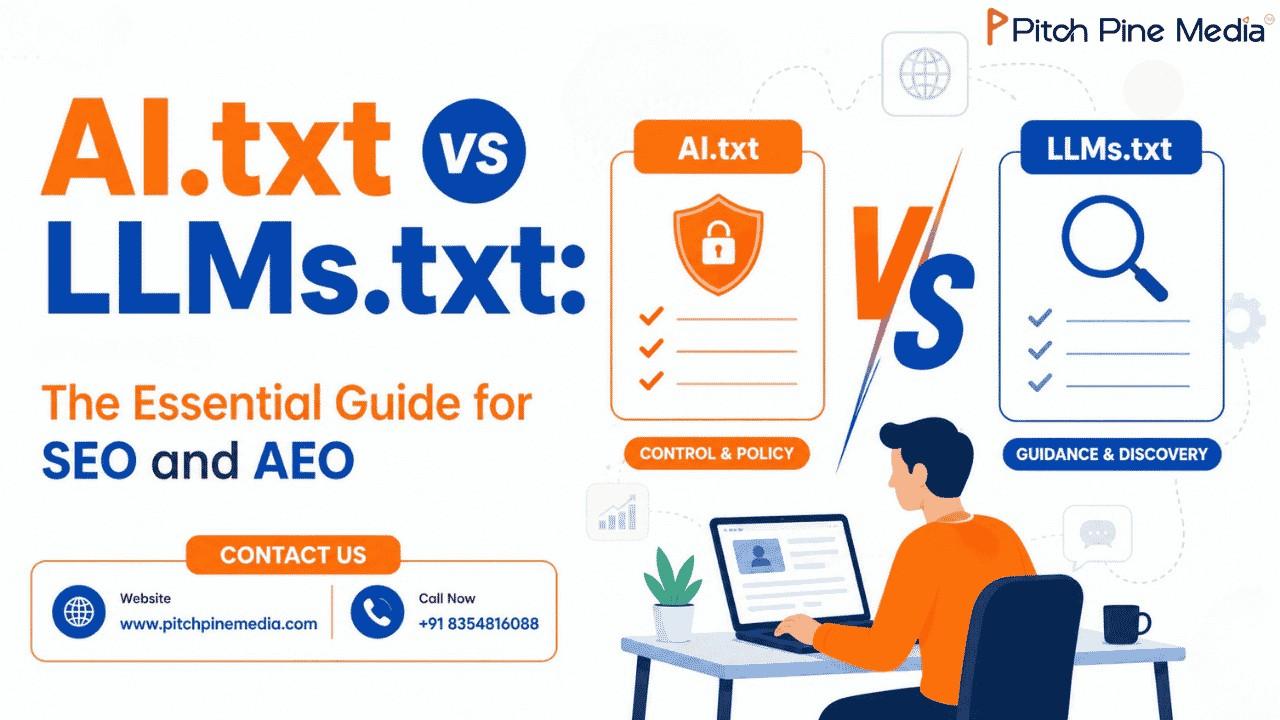
AI.txt and LLMs.txt are both part of the newer conversation around how websites communicate with AI systems. The two files are often mentioned together, but they do different jobs. The AI.txt file is usually tied to control and policy. The LLMs.txt file is usually tied to guidance and content discovery.
For brands focused on AI search optimization, Answer Engine Optimization (AEO), and Generative Engine Optimization (GEO), this difference matters. Search is no longer only about rankings on one page. AI tools now read, summarize, compare, and recommend content in ways that depend on how clear and structured the website is.
What AI.txt does
The AI.txt file is generally discussed as a way to signal how AI systems should treat a website’s content. That may include how content can be used, whether it should be included in model training, or how AI crawlers should interpret the site’s usage policy. It works more like a permission layer than a visibility layer.
That distinction is important. A file that sets boundaries is not the same as a file that improves rankings or citations. The AI.txt file may help a brand express its preferences around AI use, but it does not automatically create more traffic, more mentions, or stronger placement in answer engines. In practical terms, it is more about control than growth.
What LLMs.txt does
The LLMs.txt file, on the other hand, is normally provided as a neat instruction manual to be used by large language models as well as other AI technologies. The main aim of this file is to direct AI technologies towards the most useful pages of a website. As opposed to exerting control, it provides a way of organizing the website for machine reading.
This will make it very useful for both AEO and GEO. AI technologies are more effective when there is ease of scanning, summarizing and connecting content to its correct subject matter. This is made possible by having an LLMs.txt file which directs priority to the right pages and thus making the website more comprehensible.
The core difference
The easiest way to understand AI.txt vs LLMs.txt is to think of one as policy and the other as direction.
- The AI.txt file focuses on how AI systems may use content.
- The LLMs.txt file focuses on where AI systems should look.
- AI.txt is about permission and control.
- LLMs.txt is about structure and guidance.
- Neither file replaces strong SEO fundamentals.
That last point is where many people get it wrong. These files can support a broader visibility strategy, but they are not a shortcut. A website still needs useful content, clean technical setup, and strong internal structure before these files can do much.
| Feature | AI.txt File | LLMs.tst File |
| Purpose | Content permission | Content discovery |
| Focus | AI access and usage | AI understanding |
| Audience | AI crawlers | Large language models |
| Function | Rules and preferences | Content guidance |
| SEO Impact | Indirect | Indirect |
| AEO Impact | Limited | Potentially Stronger |
Why SEO still matters
While AI-based searches gain popularity, traditional SEO practices remain the basic layer for them. Even with advanced technologies, the relevance and content quality still make the difference between a successful website and failure. When the page itself is poorly written, lacking value and structure, it will never be corrected just by a file.
This is why AI-based search engine optimization always begins from the page itself. Proper titles, relevant headings, concise descriptions, and effective links can all contribute to making the site comprehensible. Google’s guidelines concerning AI-related optimization also emphasize the importance of creating useful, clear, and machine-readable content.
How AEO fits in
Answer Engine Optimization (AEO) is about making content easy to use in direct answer formats. AI systems look for content that gets to the point quickly, answers questions clearly, and stays focused on one topic. The LLMs.txt file can help guide models toward the right parts of the site, but the content on the page still needs to do the answering.
AEO works best when a page has:
- A clear main question or topic.
- A direct answer near the top.
- Short, readable paragraphs.
- Simple language.
- Strong supporting detail.
- Related internal links that show topical depth.
The LLMs.txt file can support those efforts by making important pages easier to find, but it cannot replace the actual answer content. That is why AEO is still mostly about content quality, structure, and intent.
How GEO fits in
Generative Engine Optimization goes a step further. GEO is about how AI systems generate responses from content, not just how they answer with short snippets. A page that is well organized, specific, and trustworthy has a better chance of being used in those generated answers.
That is where both files may have some support value. AI.txt can help define how a brand wants its content treated. LLMs.txt can help guide systems to the best pages. Still, GEO depends more heavily on the site itself. AI systems want content that is easy to interpret, easy to trust, and easy to connect to real entities and real topics.
What works better in practice
For most businesses, the best results come from combining structured content with technical SEO. That means the website should already have:
- Clear page titles and headings.
- Clean internal linking.
- Schema markup.
- Fast loading pages.
- Strong topic coverage.
- Updated content.
- Clear service and location signals.
These basics make the site easier for both search engines and AI systems to understand. AI.txt and LLMs.txt can sit on top of that setup, but they are only supporting pieces. A weak site does not become strong because a new file was added.
When to use each file
The AI.txt file may be relevant when the brand wishes to exert more control over how AI tools use their content. Similarly, the LLMs.txt file could be used by brands interested in guiding AI tools towards the most relevant webpages on their websites. It might make sense to utilize both of these files, but they shouldn’t be considered just because they are currently trending.
Instead, one should ask if a website is prepared to make use of them. For example, in the case of a poorly optimized website with bad internal linking and insufficient amounts of quality content, nothing is going to change with the introduction of such files.
Common mistakes
A lot of websites make the same mistakes when they hear about these files.
- They assume the files will improve rankings on their own.
- They add them without fixing content quality.
- They use them as a replacement for SEO.
- They ignore site structure and schema.
- They expect instant results from a support file.
That approach usually leads to disappointment. AI systems still need a clear, well built website. The files may help organize the site, but they do not create authority by themselves.
Final takeaway
AI.txt vs LLMs.txt is not a battle between two equal ranking tools. It is a comparison between two different kinds of support files. AI.txt is about control. LLMs.txt is about guidance. Both can fit into a modern SEO, AEO, and GEO strategy, but both work best when the website already has strong content and clean technical foundations.
Pitch Pine Media should position these files as support tools inside a larger visibility strategy. The brands that perform well in AI search are usually the ones that combine useful content, structured pages, and clear site signals with the right technical setup. That is the practical path, and it is still the one that matters most.