

Choosing the right domain extension is one of the most overlooked decisions in ecommerce branding and website performance. Many online businesses spend thousands on design, advertising, and SEO but fail to consider how their domain extension impacts user trust and conversions. One of the biggest debates today is the comparison between .com and .co domains.
Businesses launching a new ecommerce store often ask whether .co can perform as effectively as .com, especially when the preferred .com domain is unavailable. Understanding the impact of .com vs .co ecommerce conversion rates can help business owners make smarter branding and marketing decisions.
In today’s competitive online market, every click, trust signal, and conversion matters. The domain extension you choose influences credibility, memorability, direct traffic, and even customer confidence during checkout.
Understanding the Difference Between .Com and .Co
The .com extension stands for “commercial” and has been the dominant global domain extension for decades. Most internet users automatically associate businesses with .com websites because of familiarity and trust.
On the other hand, .co originally represented Colombia’s country code domain, but it has become widely adopted as a modern alternative to .com. Startups, technology companies, and creative brands often prefer .co because shorter and cleaner domain names are more available.
While both extensions can rank in search engines, their performance in ecommerce conversion rates often differs due to user perception and brand recognition.
Why Domain Extensions Matter in Ecommerce
An ecommerce website depends heavily on customer trust. Users share personal information, payment details, and shipping addresses. Even small trust issues can reduce conversions significantly.
A domain extension affects:
- Brand authority
- User trust
- Click-through rates
- Direct traffic accuracy
- Repeat visits
- Email credibility
- Conversion rates
For online stores competing in crowded markets, even a small increase in trust can lead to better sales performance.
.Com Domains and Consumer Trust
Most consumers naturally trust .com domains more because they have been used by major businesses for years. Customers often assume a business is more established when it uses a .com extension.
This trust factor directly impacts:
- Product purchases
- Lead generation
- Cart completions
- Email signups
Many users still manually type .com when searching for businesses online. If your brand uses .co, some visitors may accidentally land on another company’s .com version.
That confusion can lead to lost traffic and reduced conversions.
How .Co Domains Perform in Modern Ecommerce
Although .com remains dominant, .co domains have gained popularity among startups and modern digital brands. Many younger businesses choose .co because it feels short, modern, and brandable.
Benefits of .co domains include:
- Better domain availability
- Shorter brand names
- Modern startup appeal
- Easier social media consistency
However, the main challenge remains customer familiarity. Some users still perceive .co websites as less established compared to .com.
SEO Impact of .Com vs .Co Domains
From a technical SEO perspective, Google treats both .com and .co similarly. Domain extensions alone do not directly affect rankings.
However, user behavior metrics can indirectly influence SEO performance. If users trust .com more, they may:
- Stay longer on the site
- Bounce less
- Convert more frequently
- Return more often
These behavioral signals can support stronger long-term SEO performance.
Businesses investing in .com vs .co ecommerce conversion rates analysis often discover that branding and trust influence performance more than technical ranking factors.
This is why many businesses also invest in Technical SEO Services and Ecommerce SEO Services to maximize search visibility alongside branding improvements.
Which Domain Converts Better?
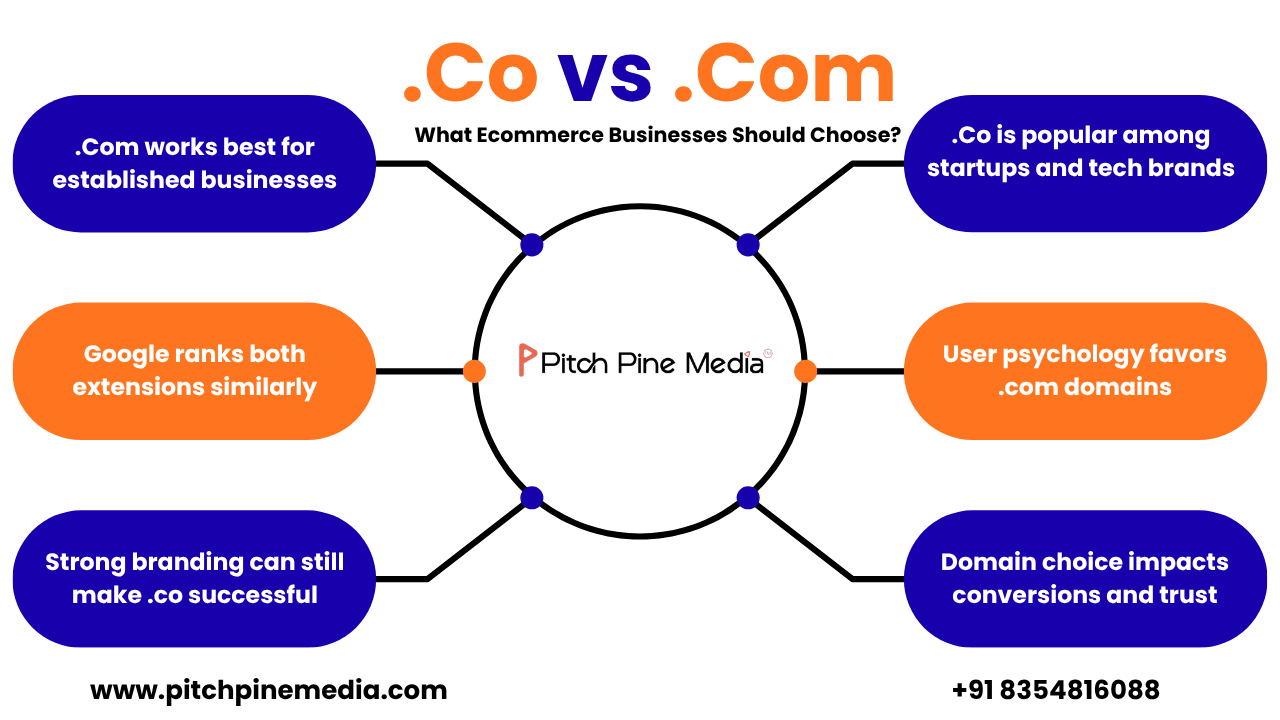
In most ecommerce industries, .com domains typically achieve better conversion rates because users trust them more instinctively.
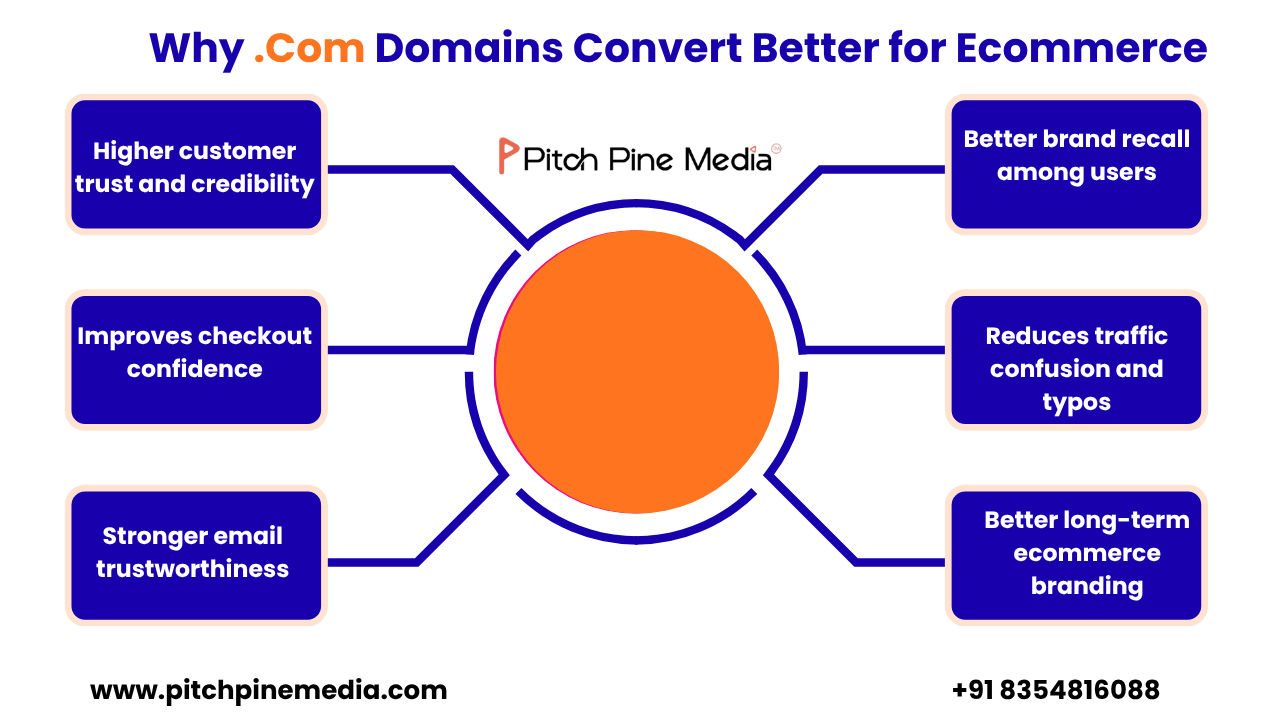
Several studies and industry observations suggest that .com domains may outperform .co domains in:
- Checkout completion rates
- Direct type-in traffic
- Brand recall
- Email trustworthiness
However, this does not mean .co domains fail to convert. A strong brand, excellent user experience, and quality products can still create high-performing ecommerce stores using .co.
The difference becomes more noticeable in highly competitive markets where trust plays a major role.
Branding Considerations for Ecommerce Stores
Your domain extension becomes part of your brand identity. Before selecting between .com and .co, consider:
Brand Recognition
.com is easier for mainstream audiences to recognize and remember.
Startup Positioning
.co often appeals more to startups, SaaS companies, and creative businesses.
Email Credibility
Customers may trust emails from .com addresses more than .co.
Marketing Campaigns
Offline marketing often works better with .com because users naturally remember it.
User Psychology and Conversion Behavior
Consumer psychology strongly affects ecommerce success. When visitors see a familiar .com extension, they subconsciously associate it with legitimacy and professionalism.
With .co, some users may hesitate momentarily, especially if they are unfamiliar with the brand.
That hesitation can impact:
- Product page engagement
- Add-to-cart behavior
- Checkout confidence
Even a small drop in trust can reduce revenue over time.
Can a .Co Domain Still Succeed?
Absolutely. Many successful companies operate on .co domains and generate strong revenue.
A .co domain can work very well when combined with:
- Strong branding
- Excellent website design
- High-quality content
- Secure checkout systems
- Fast website speed
- Effective SEO
Businesses using AI SEO Services and Local SEO Services can still achieve excellent visibility and conversion growth regardless of extension choice.
Ecommerce Conversion Factors Beyond Domain Extensions
While domain extensions matter, they are only one piece of the ecommerce conversion puzzle.
Other critical factors include:
Website Speed
Slow websites hurt conversions significantly.
Mobile Optimization
Most ecommerce traffic now comes from mobile devices.
Secure Checkout
SSL certificates and payment security increase trust.
Product Descriptions
Clear and persuasive content boosts conversions.
Customer Reviews
Social proof improves purchase confidence.
Technical SEO
Technical SEO Services help improve crawlability, performance, and search visibility.
Advertising Strategy
PPC Management Services can drive targeted traffic with strong buying intent.
Which Domain Is Better for SEO Agencies and Marketing Companies?
For digital marketing companies, .com usually provides stronger authority and memorability. Businesses such as Pitch Pine Media benefit from professional branding that supports trust and long-term growth.
A Digital Marketing Agency in Lucknow or an SEO Company in India competing internationally may find .com more beneficial for credibility.
However, .co can still work effectively for modern branding strategies, especially among startup-focused audiences.
Ecommerce Businesses That Should Choose .Com
A .com domain is generally better for:
- Large ecommerce stores
- International brands
- Established businesses
- High-trust industries
- Financial or healthcare ecommerce
- Traditional retail businesses
These industries benefit greatly from immediate customer trust.
Businesses That Can Successfully Use .Co
A .co domain can work well for:
- Tech startups
- Creative agencies
- SaaS companies
- Modern lifestyle brands
- Minimalist ecommerce brands
These audiences are often more familiar with alternative domain extensions.
The Cost Difference Between .Com and .Co
In many cases, premium .com domains can be expensive because availability is limited. Businesses may choose .co simply because their preferred brand name is unavailable in .com.
If branding consistency matters more than extension familiarity, .co can still be a smart option.
However, businesses should weigh:
- long-term branding
- customer trust
- advertising performance
- direct traffic confusion
before making the final decision.
Does Google Prefer .Com Over .Co?
Google officially states that domain extensions do not directly affect rankings. A .co website can rank just as well as a .com website when supported by strong SEO practices.
That said, user trust and click behavior can indirectly influence performance over time.
This is why many businesses combine strong branding with:
- Ecommerce SEO Services
- SEO for Small Businesses
- White Label SEO Agency partnerships
- Technical SEO Services
to maximize long-term growth.
Common Mistakes When Choosing a Domain
Choosing Trend Over Trust
Some businesses pick trendy domains without considering user confidence.
Ignoring Brand Confusion
Customers may accidentally visit the .com competitor version.
Forgetting Email Credibility
Professional email trust matters in ecommerce.
Prioritizing Availability Only
A cheaper domain is not always the best long-term business decision.
Final Verdict: .Com vs .Co Ecommerce Conversion Rates
When comparing .com vs .co ecommerce conversion rates, .com generally performs better in terms of trust, familiarity, and customer confidence. It remains the strongest option for most ecommerce businesses seeking maximum credibility and conversions.
However, .co domains can still succeed when supported by:
- strong branding
- modern design
- quality SEO
- excellent user experience
- strategic marketing
Ultimately, the best domain extension depends on your audience, branding goals, and long-term growth strategy.
Businesses aiming for strong online visibility, higher conversions, and sustainable growth should combine the right domain strategy with expert digital marketing support.
Frequently Asked Questions
Q. Is .com better than .co for ecommerce websites?
Ans: In most cases, yes. .com domains usually create higher customer trust and better conversion rates.
Q. Can a .co domain rank on Google?
Ans: Yes. Google treats .co and .com similarly for SEO rankings.
Q. Why do ecommerce businesses prefer .com?
Ans: Because customers are more familiar with .com, which improves credibility and trust.
Q. Is .co good for startups?
Ans: Yes. Many startups and modern brands use .co successfully because of better domain availability.
Q. Does domain extension affect SEO?
Ans: Not directly. However, user behavior and trust can indirectly influence SEO performance.
Q. Which domain extension is best for conversions?
Ans: For most ecommerce businesses, .com tends to produce better conversion performance.
Q. Should small businesses choose .com or .co?
Ans: If available and affordable, .com is usually the safer long-term choice for SEO for Small Businesses and brand trust.
Q. Can I switch from .co to .com later?
Ans: Yes, but it requires proper redirects, SEO migration planning, and branding updates.